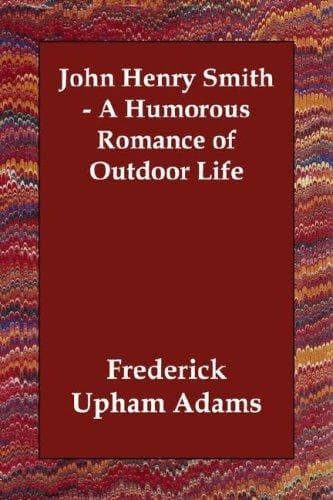
John Henry Smith: A humorous romance of outdoor lifeAdams, Frederick Upham
General
John Henry Smith: A humorous romance of outdoor life
Adams, Frederick Upham
Humorous stories; Outdoor life -- Fiction
"I hav'n't finished my story," said Mr. Bishop, after these and other
comments had-been made. "I reckon the water was some cold, and the air
colder; at any rate I happened along in my wagon just as they were
draggin' them out, and before I could get them up to Smith's father's
house the whole bunch of them was frozen so stiff that I had to pack 'em
into the kitchen like so much cordwood."
"But boys of that age are tough, and when they had been thawed out,
boiled in hot baths, and blistered with mustard poultices they was as
good as new, and I reckon the Anderson kids was a mighty sight cleaner
than they had been since the last time they went in swimmin'."
"Now, as I said before, these Andersons were desperate poor, but they
were good folks, and what you might call appreciative. Jack had saved
the lives of two of the family, and they wanted to show what they
thought of him in some way or other. There was twelve children in the
Anderson family, six boys and six girls, and the older girls and the old
lady went to work, and blamed if they didn't knit a dozen pair of
woollen socks and sent them to Jack as a Christmas present."
"And that is how Jack got the name of 'Socks Smith,'" concluded Mr.
Bishop, when the laughter had subsided. "For riskin' his life he got all
those nice warm socks and a nickname that uster make him so darned mad
that I suppose he's had a hundred fights on account of it, and I'm not
certain he won't poke me in the jaw when he gets me alone for tellin'
this yarn on him."
"This darned woollen yarn," observed Marshall.
"You're all right, Socks," declared Chilvers. "I only wish I could get
as good a press agent as our friend Bishop. When I was a kid I used to
push 'em into the pond and run, and let someone else fish them out."
"If a man were to do an act as brave as that," asserted Miss Harding,
"the world would acclaim him a hero, and not pile ridicule on him."
"All of which proves that no boy is a hero to another boy," commented
Mr. Harding, "and that is as it should be. Boys get their heroes out of
books, and as a rule they are fighters and pirates rather than of the
self-sacrificing type."
I was glad when Miss Lawrence changed the topic of conversation.
"What do you think?" she exclaimed, addressing no one in particular, "I
have discovered that Mr. Wallace knows how to play golf, and that he
learned the game on some of the famous old courses of Scotland. He has
promised to teach me the St. Andrews swing."
LaHume's face was a study as Miss Lawrence made this rather startling
announcement. Surprise, disgust, and anger were reflected in his eyes
and in the lines of his mouth.
"You have played St. Andrews?" asked Carter of Wallace.
"Yes, many a time," said this remarkable "hired man." "I was born
hard-by the old town," he added.
"Indeed?" sneered LaHume. "What were you while there; caddy or
professional?"
Public-domain text, read in full here on John Shaqi.
Reviews
Reviews
No reviews yet
Be the first to share your thoughts on this work.
Elsewhere in the archive
Join the Discussion
Join the discussion
Sign in to leave a comment or review.
Sign InorCreate an account