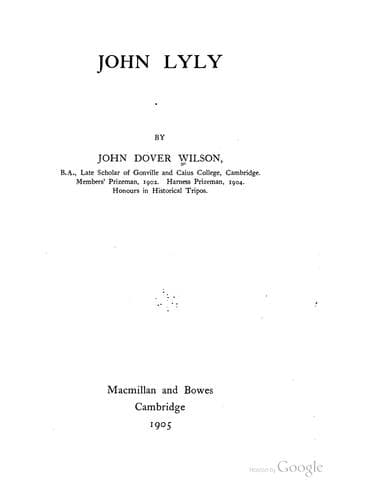
Lyly, John, 1554?-1606 -- Criticism and interpretation
The whole motive of the play, which would have been meaningless to a
mediaeval audience, is a compliment to the ladies. It is as if our
author nets Mars with Venus, and presents the shamefaced god as an
offering of flattery to the Queen and her Court. _Campaspe_ is, in fact,
the first romantic drama, not only the forerunner of Shakespeare, but a
remote ancestor of _Hernani_ and the 19th century French theatre. "The
play's defect," says Mr Bond, "is one of passion"--a criticism which is
applicable to all Lyly's dramas; and yet we must not forget that Lyly
was the earliest to deal with passion dramatically. The love of
Alexander is certainly unemotional, not to say callous; but possibly the
great monarch's equanimity was a veiled tribute to the supposed
indifference of the virgin Queen to all matters of Cupid's trade.
Between Campaspe and Apelles, however, we have scenes which are imbued,
if not vitalized, by passion. Lyly was a beginner, and his fault lay in
attempting too much. Caring more for brilliancy of dialogue than for
anything else, he was no more likely to be successful here, in
portraying passion through conversation weighted by euphuism, than he
had been in his novel. Yet his endeavour to depict the conflict of
masculine passion with feminine wit, impatient sallies neatly parried,
deliberate lunges quietly turned aside, was in every way praiseworthy.
"A witte apt to conceive and quickest to answer" is attributed by
Alexander to Campaspe, and, though she exhibits few signs of it, yet in
his very idea of endowing women with wit Lyly leads us on to the
high-road of comedy leading to Congreve.
[114] From _Prologue_ at the Court.
In addition to the romantic elements above described, we have here also
that page-prattle which is so characteristic of all Lyly's plays. These
urchins, full of mischief and delighting in quips, were probably
borrowed from Edwardes, but Lyly made them all his own; and one can
understand how naturally their parts would be played by his boy-actors.
Their repartee, when it is not pulling to pieces some Latin quotation
familiar to them at school, or ridiculing a point of logic, is often
really witty. One of them, overhearing the hungry Manes at strife with
Diogenes over the matter of an overdue dinner, exclaims to his friend,
"This is their use, nowe do they dine one upon another." Diogenes again,
in whom we may see the prototype of Shakespeare's Timon, is amusing
enough at times with his "dogged" snarlings and sallies which
frequently however miss their mark. He and the pages form an underplot
of farce, upon which Lyly improved in his later plays, bringing it also
more into connexion with the main plot. In passing, we may notice that
few of Shakespeare's plays are without this farcical substratum.
Public-domain text, read in full here on John Shaqi.
Reviews
Reviews
No reviews yet
Be the first to share your thoughts on this work.
Elsewhere in the archive
Join the Discussion
Join the discussion
Sign in to leave a comment or review.
Sign InorCreate an account