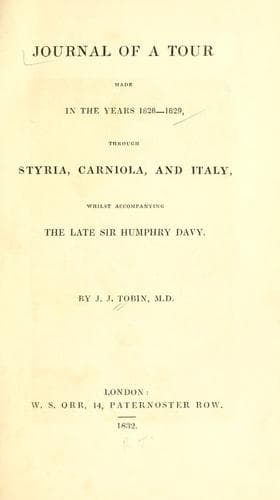
Journal of a Tour in the Years 1828-1829, through Styria, Carniola, and Italy, whilst Accompanying the Late Sir Humphry DavyTobin, J. J.
History
Journal of a Tour in the Years 1828-1829, through Styria, Carniola, and Italy, whilst Accompanying the Late Sir Humphry Davy
Tobin, J. J.
Davy, Humphry, Sir, 1778-1829; Europe -- Description and travel
_24th._ We left Wurzen this morning in a little carriage, and drove
over very bad roads up the valley to Tarvis, a small and old town,
through which the high road from Italy to Carinthia and Vienna passes.
The only manufactures of the town appear to be of iron and steel. We
here took another road to the left, up the valley of Raibl, along
the banks of a foaming mountain torrent, till we reached the little
village of the same name, where we arrived about twelve o'clock. Raibl
lies at the foot of the Königsberg, a lofty mountain containing very
productive lead mines, and is only inhabited by miners. There is a
small but very decent inn in the village; immediately in the front of
it rises a lofty Alp of very singular form, its rocky and barren summit
being split into five rounded peaks or cones. Whilst Sir Humphry took
a luncheon, I drew a sketch of the place, and we then set out for the
source of the Isonzo, which the postmaster of Wurzen, who accompanied
us as a guide, assured us was at a short distance up the mountain,
and that the road to it was very good. Sir Humphry proceeded in this
carriage whilst I walked up the mountain with the postmaster, and a
friend of his from Raibl, neither of whom seemed to know much about the
Isonzo or its source, for after a long walk they conducted us to a
valley in the middle of which ran a small stream, which the postmaster
declared was the Isonzo. This, however, both to Sir Humphry and me,
appeared impossible on comparing its situation and direction with that
of the Isonzo, as traced on our maps, and after a long discussion with
the postmaster and his friend, the latter admitted they were wrong,
and that it was the Pless, or Fletzbach, a little mountain river, a
tributary stream of the Isonzo, whose source, from all the information
we could gain, lies in a very different direction, at least ten miles
off, and in a very wild and barren country.
Sir Humphry was sadly disappointed and very angry with the postmaster,
who had assured us at Wurzen that he was well acquainted with the
source. We had however enjoyed some very fine wild scenery, and had
seen many beautiful small cascades leaping from the mountains. On our
road we passed a knoll of ground where the grass grew more luxuriantly
than any where else, and we learnt that this spot had been the grave
of some hundred Austrians, who had bravely defended a small fort which
stood here, against the French; of the whole garrison three or four
only escaped the slaughter. At that time the French had possession of
the whole surrounding country, and had thrice sent to the Austrians a
flag of truce, assuring them that resistance was vain. The inhabitants
of Raibl still speak with horror of this action, in which the Austrians
fought with desperate enthusiasm, led on by their commander, Major
Hermann, who, it is said, wished for death, and if so he could scarcely
have found a more wildly romantic spot in which to have parted with
life.
Public-domain text, read in full here on John Shaqi.
Reviews
Reviews
No reviews yet
Be the first to share your thoughts on this work.
Join the Discussion
Join the discussion
Sign in to leave a comment or review.
Sign InorCreate an account