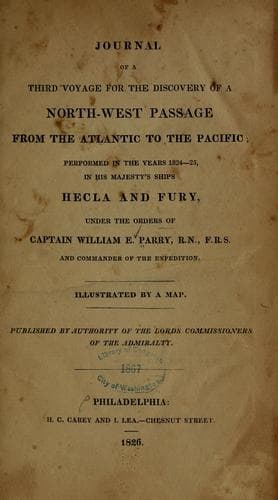
Journal of the Third Voyage for the Discovery of a North-West PassageParry, William Edward, Sir
History
Journal of the Third Voyage for the Discovery of a North-West Passage
Parry, William Edward, Sir
Arctic regions -- Discovery and exploration -- British; Fury (Ship); Hecla (Ship); Northwest Passage
little from the shore and prepared the _Hecla_ for casting by a spring at
a moment’s notice, all the people except those at the pumps were sent to
rest, which, however, they had not enjoyed for two hours, when at four
A.M. on the 21st, another heavy mass coming violently in contact with the
bergs and cables, threatened to sweep away every remaining security. Our
situation, with this additional strain, the mass which had disturbed us
fixing itself upon the weather-cable, and an increasing wind and swell
setting considerably on the shore, became more and more precarious; and
indeed, under circumstances as critical as can well be imagined, nothing
but the urgency and importance of the object we had in view—that of
saving the _Fury_ if she was to be saved—could have prevented my making
sail, and keeping the _Hecla_ under way till matters mended. More
hawsers were run out, however, and enabled us still to hold on; and after
six hours of disturbed rest, all hands were again set to work to get the
_Fury’s_ anchors, cables, rudder, and spars on board, these things being
absolutely necessary for her equipment, should we be able to get her out.
At two P.M. the crews were called on board to dinner, which they had not
finished when several not very large masses of ice drove along the shore
near us at a quick rate, and two or three successively coming in violent
contact either with the _Hecla_ or the bergs to which she was attached,
convinced me that very little additional pressure would tear everything
away, and drive both ships on shore. I saw that the moment had arrived
when the _Hecla_ could no longer be kept in her present situation with
the smallest chance of safety, and therefore immediately got under sail,
dispatching Captain Hoppner with every individual, except a few for
working the ship, to continue getting the things on board the _Fury_,
while the _Hecla_ stood off and on. It was a quarter-past three P.M.
when we cast off, the wind then blowing fresh from the north-east, or
about two points upon the land, which caused some surf on the beach.
Captain Hoppner had scarcely been an hour on board the _Fury_, and was
busily engaged in getting the anchors and cables on board, when we
observed some large pieces of not very heavy ice closing in with the land
near her; and at twenty minutes past four P.M., being an hour and five
minutes after the _Hecla_ had cast off, I was informed by signal that the
_Fury_ was on shore. Making a tack in-shore, but not being able, even
under a press of canvas, to get very near her, owing to a strong
southerly current which prevailed within a mile or two of the land, I
perceived that she had been apparently driven up the beach by two or
three of the grounded masses forcing her onwards before them, and these,
as well as the ship, seemed now so firmly aground as entirely to block
her in on the seaward side. As the navigating of the _Hecla_ with only
ten men on board required constant attention and care, I could not at
Public-domain text, read in full here on John Shaqi.
Reviews
Reviews
No reviews yet
Be the first to share your thoughts on this work.
Elsewhere in the archive
Join the Discussion
Join the discussion
Sign in to leave a comment or review.
Sign InorCreate an account