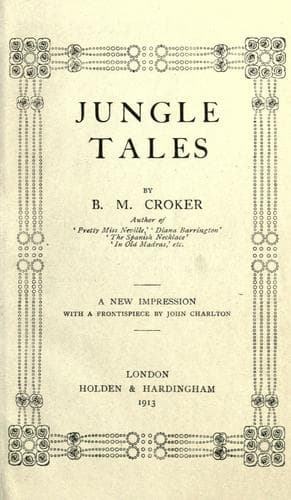
British -- India -- Fiction; India -- History -- British occupation, 1765-1947 -- Fiction; Short stories
As these ideas were working in his brain, and he was the sport of two
conflicting feelings, Chūnnee was rapidly approaching his little hovel,
which lay on the outskirts of the village of Paroor. It was a small
hamlet of mud houses, huddled together most irregularly. There was no
main street, nor even an attempt at one; no chief entrance--merely half
a dozen footpaths running into the village from various directions.
There would be a high mud wall and doorway leading into an enclosure,
containing twenty small huts, and as many families, all connected;
here were also ponies, calves, fowl, the property of the clan, and
perchance a bullock-cart or a sugar-press. These enclosures were set
down indiscriminately, and joined together; the only village street, an
irregular path, that threaded its way between them. There were “sets”
even here, as in higher circles; inmates of one mud courtyard, who
owned a sugar-press, looked down on the inmates of those who had none.
Most people looked down on Chūnnee, the coolie--even the women,
although he was a handsome, well-made fellow. What are looks, when a
man has not a pice, and owns nought save two crying children? Chūnnee
made his way past a crowd collected round a khooloo, or sugar-mill--a
rude, wooden affair, turned by two bullocks, fed with bits of raw cane,
which it squeezes into a receptacle in the ground, and subsequently
empties into another vat indoors, where the sugar is boiled, and
finally poured off into huge jars (similar to those which contained the
forty thieves), and sent to middlemen, who thereby reap much profit.
Paroor was in the midst of a sugar country, and boasted half a dozen
of these rude sugar-mills.
Chūnnee passed through the scattered strips of cane, basket in
hand--there were no greetings for him--and, turning a corner, dived
between two mud walls into a small hut that stood by itself. A slim,
nearly naked lad ran out to meet him, with a look of expectation on his
intelligent face, but, alas! his father was empty-handed. On the mat
lay a little girl with curly hair and a fair but puny face. She was
fast asleep, holding in her arms a miserably thin bazaar kitten--or it
might be a full-grown cat stunted in size.
“She was hungry; I fetched her some banka fruit from cows--now she is
asleep,” explained the boy. “There is a little barley--the last--I made
it,” and he pointed to a cake, a very small one, baking on some embers.
“Father, what shall we do to-morrow?” he asked, as his father devoured
the only food he had seen that day.
“There is still the reaping-hook.”
“Gunesh offers two annas for it.”
“And it cost a rupee and a half.”
“I went to-day to old Turroo, to ask him for a few cowries, or a bit
of a chupatti for Gyannia--she was crying with hunger, and calling for
food.”
“And what did he give thee?”
“He smote me a blow on the back with his staff”--pointing to a weal on
his shoulder. “He said I was a devil’s spawn, good for nothing; like
thee--a beggar.”
Public-domain text, read in full here on John Shaqi.
Reviews
Reviews
No reviews yet
Be the first to share your thoughts on this work.
Elsewhere in the archive
Join the Discussion
Join the discussion
Sign in to leave a comment or review.
Sign InorCreate an account