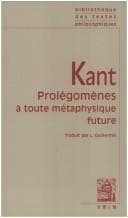
Kant's Prolegomena to Any Future MetaphysicsKant, Immanuel
PhilosophyPhilosophy
Kant's Prolegomena to Any Future Metaphysics
Kant, Immanuel
Knowledge, Theory of -- Early works to 1800; Metaphysics -- Early works to 1800
There can be nothing more desirable to a philosopher, than to be able
to derive the scattered multiplicity of the concepts or the
principles, which had occurred to him in concrete use, from a
principle a priori, and to unite everything in this way in one
cognition. He formerly only believed that those things, which remained
after a certain abstraction, and seemed by comparison among one
another to constitute a particular kind of cognitions, were completely
collected; but this was only an Aggregate. Now he knows, that just so
many, neither more nor less, can constitute the mode of cognition, and
perceives the necessity of his division, which constitutes
comprehension; and now only he has attained a System.
To search in our daily cognition for the concepts, which do not rest
upon particular experience, and yet occur in all cognition of
experience, where they as it were constitute the mere form of
connexion, presupposes neither greater reflexion nor deeper insight,
than to detect in a language the rules of the actual use of words
generally, and thus to collect elements for a grammar. In fact both
researches are very nearly related, even though we are not able to
give a reason why each language has just this and no other formal
constitution, and still less why an exact number of such formal
determinations in general are found in it.
Aristotle collected ten pure elementary concepts under the name of
Categories.{23} To these, which are also called predicaments, he found
himself obliged afterwards to add five post-predicaments,{24} some of
which however (prius, simul, and motus) are contained in the former;
but this random collection must be considered (and commended) as a
mere hint for future inquirers, not as a regularly developed idea, and
hence it has, in the present more advanced state of philosophy, been
rejected as quite useless.
===================================
{23} 1. Substantia. 2. Qualitas. 3. Quantitas. 4. Relatio, 5. Actio.
6. Passio. 7. Quando, 8. Ubi. 9. Situs. 10. Habitus.
{24} Oppositum. Prius. Simul. Motus. Habere.
===================================
After long reflexion on the pure elements of human knowledge (those
which contain nothing empirical), I at last succeeded in
distinguishing with certainty and in separating the pure elementary
notions of the Sensibility (space and time) from those of the
Understanding. Thus the 7th, 8th, and 9th Categories had to be
excluded from the old list. And the others were of no service to me;
because there was no principle [in them], on which the understanding
could be investigated, measured in its completion, and all the
functions, whence its pure concepts arise, determined exhaustively and
with precision.
Public-domain text, read in full here on John Shaqi.
Reviews
Reviews
No reviews yet
Be the first to share your thoughts on this work.
Join the Discussion
Join the discussion
Sign in to leave a comment or review.
Sign InorCreate an account