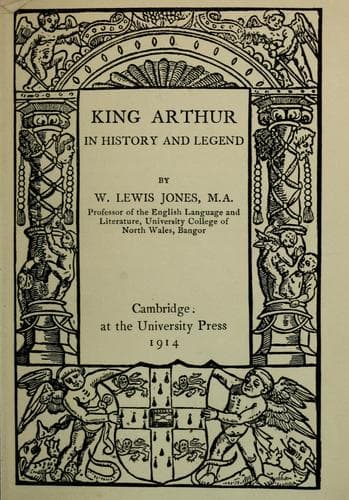
King Arthur in history and legendJones, William Lewis
History
King Arthur in history and legend
Jones, William Lewis
Arthur, King; Arthurian romances -- History and criticism
The most intricate, though not the least fascinating, problem connected
with the Arthurian legends is that of accounting for the origin, and
for the attachment to the original Arthurian stock, of the story of
the Grail and its quest. Here, at any rate, we have presented to us,
in Tennyson’s words, “Soul at war with Sense”; and it is clear enough
that the gradual manipulation of the Grail stories marks a deliberate
effort by ecclesiastical writers to neutralise the influence of the
dangerous ideals of chivalry upon Arthurian romance. Celibacy had to be
shown to be compatible with true knighthood; there was no reason why a
knight-errant should make love, and, all too often, illicit love, the
sole motive of his quest for adventure. So, we have ultimately created
for us the character of Galahad, who
“never felt the kiss of love
Nor maiden’s hand in his,”
and who alone, by virtue of his purity, is allowed to “find the Holy
Grail.” The earlier forms of the Grail legend know nothing of Galahad,
nor is there any reason for supposing that they had any religious
significance. Gawain, apparently,--he who, in his progress through the
romances, degenerates so much as to be finally described as “light in
life and light in death,”[104]--was the original hero of the Grail
quest. It is Perceval, however, who is the central figure of the
best-known versions of the story--as, for example, the _Conte del
Graal_, the Welsh _Peredur_, and Wolfram von Eschenbach’s _Parzival_.
But Perceval was not immaculate, and so had to be superseded by one
who “exemplified, in a yet more uncompromising, yet more inhuman,
spirit, the ideal of militant asceticism,”[105]--the virginal and
youngest knight of the Round Table, Galahad. And, in order to establish
Galahad’s right to a place in the Arthurian fellowship, he is
introduced as the son of Lancelot. Here is an artistic touch deserving
much more appreciation than it has yet generally received. The sin of
Lancelot is largely expiated by the unsullied purity of his son. Truly,
the “militant ascetics” knew their romantic business as well as the
best of the secular scribes.[106]
Public-domain text, read in full here on John Shaqi.
Reviews
Reviews
No reviews yet
Be the first to share your thoughts on this work.
Join the Discussion
Join the discussion
Sign in to leave a comment or review.
Sign InorCreate an account