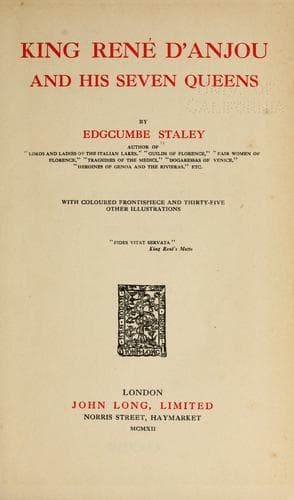
King René d'Anjou and His Seven QueensStaley, Edgcumbe
History
King René d'Anjou and His Seven Queens
Staley, Edgcumbe
France -- Court and courtiers; René I, King of Naples and Jerusalem, 1409-1480
Nowhere did the mysterious tidings create greater interest than
among the members of the Royal Families and Courts of Sicily-Anjou
and France. When the news of Jeanne d’Arc’s arrival with Duke René
reached Angers, Queen Yolande set out at once for Chinon, that she
might judge for herself of the girl and her mission. Very greatly
struck was the Queen by the maid’s youth, comeliness, and innocence.
Her simple manners and unaffected devotion convinced Yolande that she
had no adventuress to deal with. She conversed freely with her, and her
simple narrative and fearless courage determined her to take the maid
under her direct patronage. When it was proposed to inquire formally
into Jeanne’s character and mental bias, the Queen promptly allocated
to herself that duty. She called to her assistance three ladies of her
Court of good repute. Jehan Pasquerelle has quaintly recorded this
plenary council of matrons: “_Fust icelle Pucelle baillée à la Royne
de Cecile, mère de la Royne, nostre souveraine, et à certaines dames
d’estant avec elle, dont estoient les Dames de Gaucourt, de Fiennes, et
de Trèves_.” Another chronicler adds the name of Jeanne de Mortèmar,
wife of the Chancellor, Robert le Maçon. Their verdict was a complete
vindication of Jeanne’s honour and sincerity.
The tongue of slander had associated René and Jeanne in a liaison. The
Court of Chinon was full of evil gossip, and the more ill-conditioned
courtiers and hirelings, both men and women, revelled in compromising
insinuations and coarse jests. Queen Yolande determined once and for
all to put an end to these baseless and foul rumours. She knew her son
too well to doubt his honour, and now she pledged herself to defend
that of the village maid. Several of the offenders were dismissed the
service of the King, and warned to hold their tongue, unless they
wished for condign punishment.
History has done scant justice to Queen Yolande for the part she bore
in the drama of Jeanne d’Arc. It was in a very great measure due to her
that the maid’s mission was carried out. Whilst Charles was dallying
with his idle associates and procrastinating in his military measures,
Yolande played the man. Her intrepid counsels and fearless insistence
were the levers which moved her son-in-law’s inertness. There is a
story told that, when Queen Marie’s gentle chiding had failed to rouse
her desponding consort, Queen Yolande appeared before him clothed in
full armour, and demanded why the King of France skulked in his castle!
“See, Charles,” she said, “if you refuse to follow _La Pucelle_ at once
and do your duty to God and to your country, I will go forth as your
lieutenant, and in person lead your army against the English. But shame
to you to trust in a woman’s arm rather than your own! Rouse you like a
man, and begone!”
Public-domain text, read in full here on John Shaqi.
Reviews
Reviews
No reviews yet
Be the first to share your thoughts on this work.
Join the Discussion
Join the discussion
Sign in to leave a comment or review.
Sign InorCreate an account