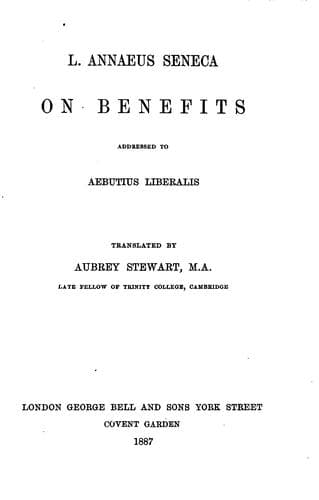
L. Annaeus Seneca on BenefitsSeneca, Lucius Annaeus
Philosophy
L. Annaeus Seneca on Benefits
Seneca, Lucius Annaeus
Benevolence; Classical literature; Conduct of life; Essays
XXVIII. After so many instances, can we doubt that a master may
sometimes receive a benefit from a slave? Why need the person of the
giver detract from the thing which he gives? why should not the gift add
rather to the glory of the giver. All men descend from the same original
stock; no one is better born than another, except in so far as his
disposition is nobler and better suited for the performance of good
actions. Those who display portraits of their ancestors in their halls,
and set up in the entrance to their houses the pedigree of their family
drawn out at length, with many complicated collateral branches, are they
not notorious rather than noble? The universe is the one parent of all,
whether they trace their descent from this primary source through a
glorious or a mean line of ancestors. Be not deceived when men who are
reckoning up their genealogy, wherever an illustrious name is wanting,
foist in that of a god in its place. You need despise no one, even
though he bears a commonplace name, and owes little to fortune. Whether
your immediate ancestors were freedmen, or slaves, or foreigners, pluck
up your spirits boldly, and leap over any intervening disgraces of your
pedigree; at its source, a noble origin awaits you. Why should our
pride inflate us to such a degree that we think it beneath us to receive
benefits from slaves, and think only of their position, forgetting their
good deeds? You, the slave of lust, of gluttony, of a harlot, nay, who
are owned as a joint chattel by harlots, can you call anyone else
a slave? Call a man a slave? why, I pray you, whither are you being
hurried by those bearers who carry your litter? whither are these men
with their smart military-looking cloaks carrying you? is it not to the
door of some door-keeper, or to the gardens of some one who has not even
a subordinate office? and then you, who regard the salute of another
man's slave as a benefit, declare that you cannot receive a benefit from
your own slave. What inconsistency is this? At the same time you despise
and fawn upon slaves, you are haughty and violent at home, while out of
doors you are meek, and as much despised as you despise your slaves;
for none abase themselves lower than those who unconscionably give
themselves airs, nor are anymore prepared to trample upon others than
those who have learned how to offer insults by having endured them.
XXIX. I felt it my duty to say this, in order to crush the arrogance of
men who are themselves at the mercy of fortune, and to claim the right
of bestowing a benefit for slaves, in order that I may claim it also for
sons. The question arises, whether children can ever bestow upon their
parents greater benefits than those which they have received from them.
Public-domain text, read in full here on John Shaqi.
Reviews
Reviews
No reviews yet
Be the first to share your thoughts on this work.
Elsewhere in the archive
Join the Discussion
Join the discussion
Sign in to leave a comment or review.
Sign InorCreate an account