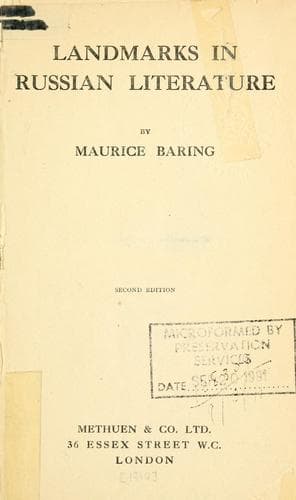
Russian literature -- 19th century -- History and criticism
However this may be, at the present time Dostoievsky’s fame in
Russia is every day becoming more universally and more emphatically
recognised. The present generation are inclined to consider him the
greatest of all their novelists; and although they as a rule, with the
critic Merejkowski, put him equal with Tolstoy as one of the two great
pillars which uphold the Temple of Russian literature, they are for
the most part agreed in thinking that he was a unique product, a more
startling revelation and embodiment of genius, a greater elemental
force, than Tolstoy or any other Russian writer of fiction. In fact,
they hold the same view about him that we do with regard to Shelley in
our poetical literature. We may not think that Shelley is a greater
poet than Keats, Wordsworth, Coleridge or Byron, but he certainly is
a more exceptional incarnation of poetical genius. We can imagine
poets like Keats arising again,--one nearly akin to him and almost
equally exquisite did appear in the shape of Tennyson. We can imagine
there being other writers who would attain to Wordsworth’s simplicity
and communion with nature, but Shelley has as yet been without kith
or kindred, without mate or equal, in the whole range of the world’s
literary history. He does not appear to us like a plant that grows
among others, differing from them only in being more beautiful and
striking, which is true even of poets like Shakespeare, Dante and
Goethe, who reveal in the highest degree qualities which other poets
possess in a lesser degree, and complete and fulfil what the others aim
at and only partially achieve; but Shelley is altogether different in
kind: he aims at and achieves something which is beyond the range and
beyond the ken of other poets. It is as though he were not a man at
all, but an embodiment of certain elemental forces.
So it is with Dostoievsky. And for this reason those who admire him do
so passionately and extravagantly. It must not be thought that they
do not discern his faults, his incompleteness, and his limitations,
but the positive qualities that he possesses seem to them matchless,
and so precious, so rare, so tremendous, that they annihilate all
petty criticism. The example of Shelley may again serve us here.
Only a pedant, in the face of such flights of genius as “The Cloud,”
the “Ode to the West Wind,” “The Sensitive Plant,” or that high
pageant of grief, fantasy, of “thoughts that breathe and words that
burn,”--“Adonais,”--would apply a magnifying glass to such poems and
complain of the occasional lapses of style or of the mistakes in
grammar which may be found in them. These poems may be full of trivial
lapses of this kind, but such matters are of small account when a
poet has evoked for us a vision of what dwells beyond the veil of the
senses, and struck chords of a music which has the power and the wonder
of a miracle.
Public-domain text, read in full here on John Shaqi.
Reviews
Reviews
No reviews yet
Be the first to share your thoughts on this work.
Elsewhere in the archive
Join the Discussion
Join the discussion
Sign in to leave a comment or review.
Sign InorCreate an account