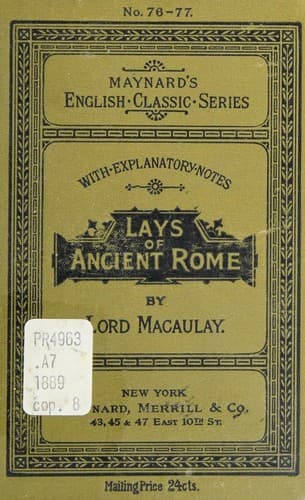
Lays of Ancient RomeMacaulay, Thomas Babington Macaulay, Baron
History
Lays of Ancient Rome
Macaulay, Thomas Babington Macaulay, Baron
Rome -- History -- Poetry
Those minstrels, as Niebuhr has remarked, appear to have
generally taken the popular side. We can hardly be mistaken in
supposing that, at the great crisis of the civil conflict, they
employed themselves in versifying all the most powerful and
virulent speeches of the Tribunes, and in heaping abuse on the
leaders of the aristocracy. Every personal defect, every domestic
scandal, every tradition dishonorable to a noble house, would be
sought out, brought into notice, and exaggerated. The illustrious
head of the aristocratical party, Marcus Furius Camillus, might
perhaps be, in some measure, protected by his venerable age and
by the memory of his great services to the state. But Appius
Claudius Crassus enjoyed no such immunity. He was descended from
a long line of ancestors distinguished by their haughty demeanor,
and by the inflexibility with which they had withstood all the
demands of the Plebeian order. While the political conduct and
the deportment of the Claudian nobles drew upon them the fiercest
public hatred, they were accused of wanting, if any credit is due
to the early history of Rome, a class of qualities which, in a
military commonwealth, is sufficient to cover a multitude of
offences. The chiefs of the family appear to have been eloquent,
versed in civil business, and learned after the fashion of their
age; but in war they were not distinguished by skill or valor.
Some of them, as if conscious where their weakness lay, had, when
filling the highest magistracies, taken internal administration
as their department of public business, and left the military
command to their colleagues. One of them had been entrusted with
an army, and had failed ignominiously. None of them had been
honored with a triumph. None of them had achieved any martial
exploit, such as those by which Lucius Quinctius Cincinnatus,
Titus Quinctius Capitolinus, Aulus Cornelius Cossus, and, above
all, the great Camillus, had extorted the reluctant esteem of the
multitude. During the Licinian conflict, Appius Claudius Crassus
signalized himself by the ability and severity with which he
harangued against the two great agitators. He would naturally,
therefore, be the favorite mark of the Plebeian satirists; nor
would they have been at a loss to find a point on which he was
open to attack.
Public-domain text, read in full here on John Shaqi.
Reviews
Reviews
No reviews yet
Be the first to share your thoughts on this work.
Join the Discussion
Join the discussion
Sign in to leave a comment or review.
Sign InorCreate an account