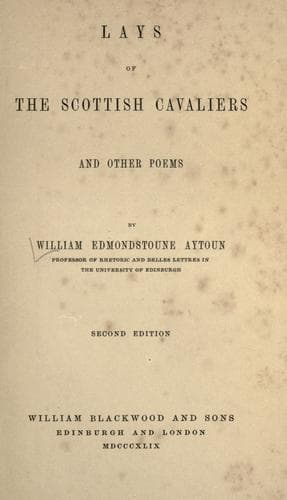
Lays of the Scottish Cavaliers and Other PoemsAytoun, William Edmondstoune
History
Lays of the Scottish Cavaliers and Other Poems
Aytoun, William Edmondstoune
Scotland -- History -- Poetry
This victory operated very much in favour of Prince Charles. It secured
him, for a season, the undisputed possession of Scotland, and enabled
numerous adherents from all parts of the country to raise such forces as
they could command, and to repair to his banner. His popularity in
Edinburgh daily increased, as the qualities of his person and mind
became known; and such testimony as the following, with respect to his
estimation by the fair sex, and the devotion they exhibited in his
cause, is not overcharged. "His affability and great personal grace
wrought him high favour with the ladies, who, as we learn from, the
letters of President Forbes, became generally so zealous in his cause,
as to have some serious effect in inducing their admirers to declare for
the Prince. There was, we know for certain, a Miss Lumsden, who plainly
told her lover, a young artist, named Robert Strange, that he might
think no more of her unless he should immediately join Prince Charles,
and thus actually prevailed upon him to take up arms. It may be added
that he survived the enterprise, escaped with great difficulty, and
married the lady. He was afterwards the best line-engraver of his time,
and received the honour of knighthood from George III. White ribbons and
breastknots became at this time conspicuous articles of female attire in
private assemblies. The ladies also showed considerable zeal in
contributing plate and other articles for the use of the Chevalier at
the palace, and in raising pecuniary subsidies for him. Many a
posset-dish and snuff-box, many a treasured necklace and repeater, many
a jewel which had adorned its successive generations of family
beauties, was at this time sold or laid in pledge, to raise a little
money for the service of Prince Charlie."
As to the motives and intended policy of this remarkable and unfortunate
young man, it may be interesting to quote the terms of the proclamation
which he issued on the 10th October, 1745, before commencing his march
into England. Let his history be impartially read, his character, as
spoken to by those who knew him best, fairly noted, and I think there
cannot be a doubt that, had he succeeded in his daring attempt, he would
have been true to the letter of his word, and fulfilled a pledge which
Britain never more required than at the period when that document was
penned:--
"Do not the pulpits and congregations of the clergy, as well as your
weekly papers, ring with the dreadful threats of popery, slavery,
tyranny, and arbitrary power, which are now ready to be imposed upon you
by the formidable powers of France and Spain? Is not my royal father
represented as a bloodthirsty tyrant, breathing out nothing but
destruction to all who will not immediately embrace an odious religion?
Or have I myself been better used? But listen only to the naked truth.
Public-domain text, read in full here on John Shaqi.
Reviews
Reviews
No reviews yet
Be the first to share your thoughts on this work.
Join the Discussion
Join the discussion
Sign in to leave a comment or review.
Sign InorCreate an account