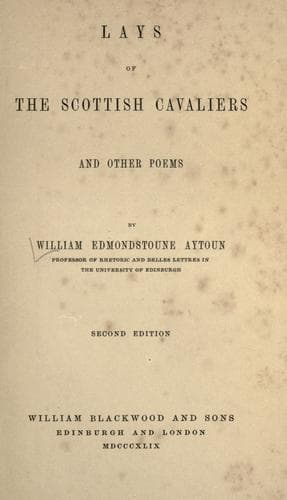
Lays of the Scottish Cavaliers and Other PoemsAytoun, William Edmondstoune
History
Lays of the Scottish Cavaliers and Other Poems
Aytoun, William Edmondstoune
Scotland -- History -- Poetry
"It is now time to conclude; and I shall do it with this reflection.
Civil wars are ever attended with rancour and ill-will, which party rage
never fails to produce in the minds of those whom different interests,
principles or views, set in opposition to one another. I, therefore,
earnestly require it of my friends to give as little loose as possible
to such passions: this will prove the most effectual means to prevent
the same in the enemies of my royal cause. And this my declaration will
vindicate to all posterity the nobleness of my undertaking, and the
generosity of my intentions."
There was much truth in the open charges preferred in this declaration
against the existing government. The sovereigns of the house of Hanover
had always shown a marked predilection for their Continental
possessions, and had proportionally neglected the affairs of Britain.
Under Walpole's administration the imperial Parliament had degenerated
from an independent assembly to a junta of placemen, and the most
flagitious system of bribery was openly practised and avowed. It was not
without reason that Charles contrasted the state of the nation then,
with its position when under the rule of the legitimate family; and had
there not been a strong, though, I think, unreasonable suspicion in the
minds of many, that his success would be the prelude to a vigorous
attack upon the established religions of the country, and that he would
be inclined to follow out in this respect the fatal policy of his
grandfather, Charles would in all probability have received a more
active and general support than was accorded to him. The zeal with which
the Episcopalian party in Scotland espoused his cause, naturally gave
rise to the idea that the attempt of the Prince was of evil omen to
Presbytery; and the settlement of the Church upon its present footing
was yet so recent, that the sores of the old feud were still festering
and green. The established clergy, therefore, were, nearly to a man,
opposed to his pretensions; and one minister of Edinburgh, at the time
when the Highland host was in possession of the city, had the courage to
conclude his prayer nearly in the following terms--"Bless the king; Thou
knows what king I mean--may his crown long sit easy on his head. And as
to this young man who has come among us to seek an earthly crown, we
beseech Thee in mercy to take him to Thyself, and give him a crown of
glory!" At the same time, it is very curious to observe, that the most
violent sect of Presbyterians, who might be considered as the
representatives of the extreme Cameronian principle, and who had early
seceded from the Church, and bitterly opposed the union of the kingdoms,
were not indisposed, on certain terms, to coalesce with the Jacobites.
It is hardly possible to understand the motives which actuated these
men, who appear to have regarded each successive government as equally
obnoxious. Some writers go the length of averring that, in 1688, a
Public-domain text, read in full here on John Shaqi.
Reviews
Reviews
No reviews yet
Be the first to share your thoughts on this work.
Join the Discussion
Join the discussion
Sign in to leave a comment or review.
Sign InorCreate an account