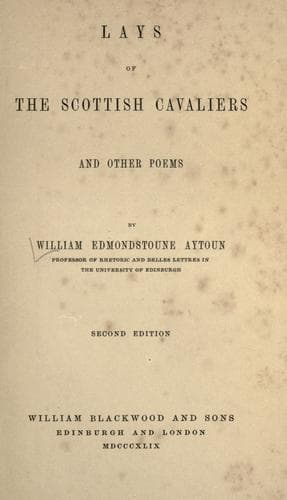
Lays of the Scottish Cavaliers and Other PoemsAytoun, William Edmondstoune
History
Lays of the Scottish Cavaliers and Other Poems
Aytoun, William Edmondstoune
Scotland -- History -- Poetry
One victory more was accorded to Prince Charles, before his final
overthrow. After successfully conducting his retreat to Scotland,
occupying Glasgow, and strengthening his army by the accession of new
recruits, he gave battle to the royal forces under General Hawley at
Falkirk, and, as at Preston, drove them from the field. The parties were
on this occasion fairly matched, there being about eight thousand men
engaged on either side. The action was short; and, though not so
decisive as the former one, gave great confidence to the insurgents. It
has been thus picturesquely portrayed by the historian of the
enterprise: "Some individuals, who beheld the battle from the steeple of
Falkirk, used to describe these, its main events, as occupying a
surprisingly brief space of time. They first saw the English army enter
the misty and storm-covered muir at the top of the hill; then saw the
dull atmosphere thickened by a fast-rolling smoke, and heard the pealing
sounds of the discharge; immediately after, they beheld the discomfited
troops burst wildly from the cloud in which they had been involved, and
rush, in far-spread disorder, over the face of the hill. From the
commencement of what they styled 'the break of the battle,' there did
not intervene more than ten minutes--so soon may an efficient body of
men become, by one transient emotion of cowardice, a feeble and
contemptible rabble.
"The rout would have been total, but for the three out-flanking
regiments. These not having been opposed by any of the clans, having a
ravine in front, and deriving some support from a small body of
dragoons, stood their ground under the command of General Huske and
Brigadier Cholmondley. When the Highlanders went past in pursuit, they
received a volley from this part of the English army, which brought them
to a pause, and caused them to draw back to their former ground, their
impression being that some ambuscade was intended. This saved the
English army from destruction. A pause took place, during which the bulk
of the English infantry got back to Falkirk. It was not until Lord
George Murray brought up the second line of his wing and the pickets,
with some others on the other wing, that General Huske drew off his
party, which he did in good order."
Public-domain text, read in full here on John Shaqi.
Reviews
Reviews
No reviews yet
Be the first to share your thoughts on this work.
Elsewhere in the archive
Join the Discussion
Join the discussion
Sign in to leave a comment or review.
Sign InorCreate an account