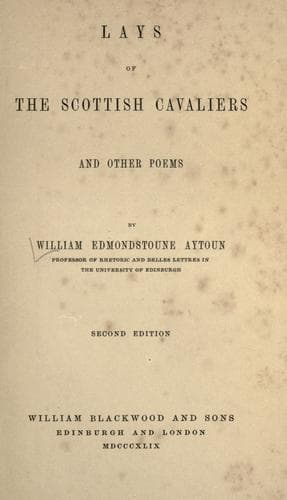
Lays of the Scottish Cavaliers and Other PoemsAytoun, William Edmondstoune
History
Lays of the Scottish Cavaliers and Other Poems
Aytoun, William Edmondstoune
Scotland -- History -- Poetry
About eleven in the forenoon, the troops of Cumberland were observed
upon the eastern extremity of the wide muir of Culloden, and
preparations were instantly made for the coming battle. The army had
been strengthened that morning by the arrival of the Keppoch Macdonalds
and a party of the Frasers; but even with these reinforcements the whole
available force which the Prince could muster was about five thousand
men, to oppose at fearful odds an enemy twice as numerous, and heavily
supported by artillery. Fortune on this day seemed to have deserted the
Prince altogether. In drawing out the line of battle, a most unlucky
arrangement was made by O'Sullivan, who acted as adjutant, whereby the
Macdonald regiments were removed from the right wing--the place which
the great clan Colla has been privileged to hold in Scottish array ever
since the auspicious battle of Bannockburn. To those who are not
acquainted with the peculiar temper and spirit of the Highlanders, and
their punctilio upon points of honour and precedence, the question of
arrangement will naturally appear a matter of little importance. But it
was not so felt by the Macdonalds, who considered their change of
position as a positive degradation, and who further looked upon it as an
evil omen to the success of the battle. The results of this mistake will
be explained immediately.
Just before the commencement of the action, the weather, which had
hitherto been fair and sunny, became overcast, and a heavy blast of rain
and sleet beat directly in the faces of the Highlanders. The English
artillery then began to play upon them, and, being admirably served,
every discharge told with fearful effect upon the ranks. The chief
object of either party at the battle of Culloden seems to have been to
force its opponent to leave his position, and to commence the attack.
Cumberland, finding that his artillery was doing such execution, had no
occasion to move; and Charles appears to have committed a great error in
abandoning a mode of warfare which was peculiarly suited for his troops,
and which, on two previous occasions, had proved eminently successful.
Had he at once ordered a general charge, and attempted to silence the
guns, the issue of the day might have been otherwise: but his
unfortunate star prevailed.
"It was not," says Mr. Chambers, "till the cannonade had continued
nearly half an hour, and the Highlanders had seen many of their kindred
stretched upon the heath, that Charles at last gave way to the necessity
of ordering a charge. The aide-de-camp intrusted to carry his message to
the Lieutenant-general--a youth of the name of Maclachlan--was killed by
a cannon-ball before he reached the first line, but the general
sentiment of the army, as reported to Lord George Murray, supplied the
want, and that general took it upon him to order an attack without
Charles's permission having been communicated.
Public-domain text, read in full here on John Shaqi.
Reviews
Reviews
No reviews yet
Be the first to share your thoughts on this work.
Elsewhere in the archive
Join the Discussion
Join the discussion
Sign in to leave a comment or review.
Sign InorCreate an account