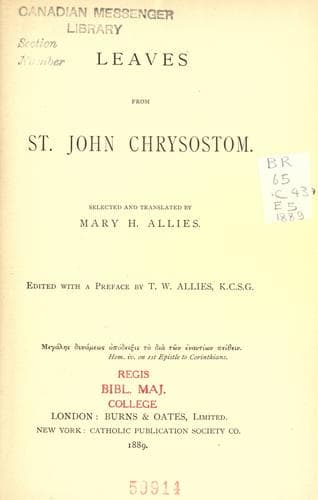
Leaves from St. John ChrysostomJohn Chrysostom, Saint
Religion
Leaves from St. John Chrysostom
John Chrysostom, Saint
Christian literature, Early; John Chrysostom, Saint, -407
Show me, if you can, whether Peter and Paul were scholars. But you
cannot; for they were ordinary men and unlettered.[7] Just as Christ,
when He sent His disciples out into the world, showed His power first to
them in Palestine, saying, _When I sent you without purse, and scrip,
and shoes, did you want anything?_ Afterwards He charged them to have a
scrip and a purse, and so He did in this case. For that which was aimed
at was to show the power of Christ, not that the lack of external
accomplishments should cause those who approached to be rejected from
the faith. Now, whenever heathens accuse the disciples of being
unlearned, let us be even louder than they in our accusations. Let no
one say that Paul was skilful, but praising great men amongst them for
their skill, and those remarkable for their clever speeches, let us say
that all of ours are unlearned. We shall not a little overthrow them on
this side too, so brilliant will be the victory. I have said these
things because I once heard a Christian making himself ridiculous in
discussion with a heathen, and each in their fight against the other
destroying his own side. That which the Christian should have said the
heathen said, and that which it would have been natural for the heathen
to say the Christian put forward. For, Paul and Plato forming the
subject of dispute, the heathen, on the one hand, tried to show that
Paul was uneducated and unlearned, and, on the other, the Christian, out
of simplicity, was all eager to prove that Paul was a better reasoner
than Plato. Thus the heathen gained the victory, as this consideration
prevailed. For, if Paul _had_ been a better dialectician than Plato,
many would naturally have used the argument that he succeeded through
his skilful speech rather than by grace. So the Christian’s argument
told for the heathen, and the heathen’s for the Christian. For if Paul
was untaught and still conquered Plato, as I have said, it was a
triumphant victory. The unlearned Paul, taking Plato’s disciples,
convinced them and drew them to himself. Hence, it is evident that the
Gospel was not preached by human wisdom, but by the grace of God. In
order, then, that we may not encounter the same defeat, nor make
ourselves ridiculous when we are thus in discussion with heathens, let
us condemn the Apostles as unlearned: this very condemnation is praise.
And when they tell us that the Apostles were rustic, let us admit and
confess that they were untaught, and unlearned, and poor, and needy, and
unintelligent, and obscure. This is no blasphemy of the Apostles, but
their glory, that, being what they were, they appeared more famous than
the whole world. Those very unlearned, rustic, untaught men beat down
men wise in their conceits, powerful men, tyrants, men who were enjoying
riches and glory and all outward goods, as if they had not been men at
all. Whence it is clear that the power of the Cross was great, and that
Public-domain text, read in full here on John Shaqi.
Reviews
Reviews
No reviews yet
Be the first to share your thoughts on this work.
Join the Discussion
Join the discussion
Sign in to leave a comment or review.
Sign InorCreate an account