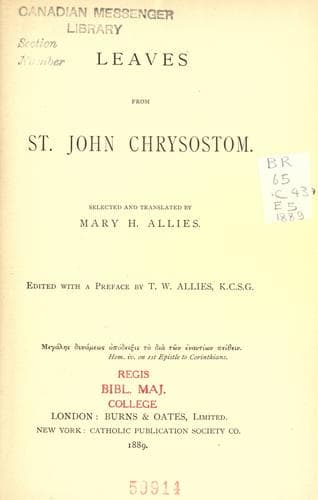
Leaves from St. John ChrysostomJohn Chrysostom, Saint
Religion
Leaves from St. John Chrysostom
John Chrysostom, Saint
Christian literature, Early; John Chrysostom, Saint, -407
You must allow me, before coming to the explanation in question, to say
something about Timothy’s goodness and Paul’s care for him. What was
kinder than he, who at so great a distance, and in a round of so much
business, made the well-being of his disciple’s stomach his care, and
told him clearly what to do for his restoration to health? And what
could equal Timothy’s virtue? He so looked down on luxury and scorned a
rich table as to grow weak from his extreme severity and excessive
fasting. Listen to Paul’s words plainly showing that he was not this by
nature, but that he had lost his strength of stomach through fasting and
water drinking; for he did not merely say, _Use a little wine_, but
saying in the first place, _Do not still drink water_, he added his
counsel about drinking wine. The _still_ was a proof that until then he
had drunk water, and had so become weak. Who would not be struck with
his mortification and severity of life? Timothy was taking heaven itself
by storm, and pressing on to the height of virtue, and to this his
master bears witness in the words: _I have sent you Timothy, who is my
beloved child and faithful in the Lord_. Now, when Paul calls him his
child, and his faithful and beloved child, these words sufficiently show
all his worth; for the judgments of the saints are not given either out
of love or hatred, but are free from all prejudice. If Timothy had been
Paul’s child according to nature, he would not have been as enviable as
he is now renowned, for whereas Timothy was nothing to him according to
the flesh, through the attraction of piety he drew him into his sonship,
preserving carefully in all things the characteristics of Timothy’s
asceticism. Just as a calf yoked with a bull, so did Timothy bear the
yoke with him all over the world, and made no difference as he grew
older, but his ardour induced him to vie with the labours of his master.
Paul, again, witnesses to this, saying: _Let no one set him at nought,
for he is doing the Lord’s work as I am myself_. Do you see how he
proclaims Timothy’s zeal as equal to his own? And that you may not think
that favouring prompted him so to speak, he makes his listeners
themselves witnesses of his child’s goodness, saying: _You know what his
test has been; how he has served with me in the Gospel as a child his
father. You have had a proof by this of his virtue and of his tried
spirit._ Yet whilst Timothy was rising to these great heights of
goodness, he did not presume of himself. On the contrary, he was in
wrestling and fear. On this account he was diligent in fasting, and did
not act as the majority of men do, who, having given themselves up to
fasting, some for ten months only, others for twenty, suddenly break up
everything. He did not suffer this, nor did he say anything of this kind
within himself: ‘Why should I go on fasting? I have got the better of
myself: I have conquered my desires, I have mortified my body, I have
Public-domain text, read in full here on John Shaqi.
Reviews
Reviews
No reviews yet
Be the first to share your thoughts on this work.
Elsewhere in the archive
Join the Discussion
Join the discussion
Sign in to leave a comment or review.
Sign InorCreate an account