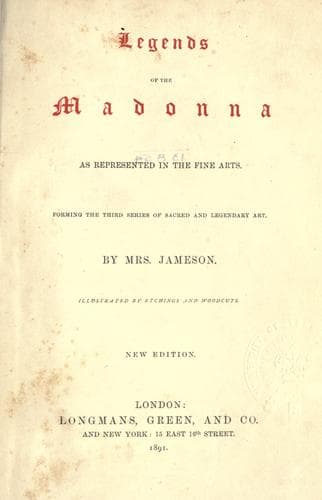
Legends of the Madonna as Represented in the Fine ArtsJameson, Mrs. (Anna)
Religion
Legends of the Madonna as Represented in the Fine Arts
Jameson, Mrs. (Anna)
Christian saints in art; Mary, Blessed Virgin, Saint -- Art; Mary, Blessed Virgin, Saint -- Legends
1. Mary is reclining in her last sickness, and around her are the
Apostles, who, according to the beautiful legend, were _miraculously_
assembled to witness her departure. To express this, one of them is
floating in as if borne on the air. St. John kneels at her feet, and
she takes, with an expression exquisitely tender and maternal, his two
hands in hers. This action is peculiar to the Siena school.[1]
[Footnote 1: On each side of the principal door of the Cathedral at
Siena, which is dedicated to "Beata Virgine Assunta," and just within
the entrance, is a magnificent pilaster, of white marble, completely
covered from the base to the capital with the most luxuriant carving,
arabesques, foliage, &c., in an admirable and finished style. On the
bases of these two pilasters are subjects from the Life of the Virgin,
three on each side, and arranged, each subject on one side having its
pendant on the other.
1. The meeting of Joachim and Anna. 2. The Nativity of Mary. 3. Her
sickness and last farewell to the Apostles; bending towards St. John,
she takes his hands in hers with the same tender expression as in
the fresco by Taddeo Bartola. 4. She lies dead on her couch. 5. The
Assumption. 6. The Coronation.
The figures are about a foot in height, delicately carved, full of
that sentiment which is especially Sienese, and treated with a truly
sculptural simplicity.]
2. She lies extended on her couch, surrounded by the weeping
Apostles, and Christ behind receives the parting soul,--the usual
representation, but treated with the utmost sentiment.
3. She is borne to the grave by the Apostles; in the background, the
walls of the city of Jerusalem. Here the Greek legend of St. Michael
protecting her remains from the sacrilegious Jew is omitted, and a
peculiar sentiment of solemnity pervades the whole scene.
4. The resurrection of the Virgin, when she rises from the tomb
sustained by hovering angels, and is received by Christ.
When I first saw these beautiful frescoes, in 1847, they were in a
very ruined state; they have since been restored in a very good style,
and with a reverent attention to the details and expression.
In general, however, the cycle commences either with the legend of
Joachim and Anna, or with the Nativity of the Virgin, and ends with
the assumption and coronation. A most interesting early example is the
series painted in fresco by Taddeo Gaddi, in the Baroncelli Chapel
at Florence. The subjects are arranged on two walls. The first on the
right hand, and the second, opposite to us as we enter.
1. Joachim is rejected from the Temple.
2. He is consoled by the Angel.
3. The meeting of Joachim and Anna.
4. The Birth of the Virgin.
Public-domain text, read in full here on John Shaqi.
Reviews
Reviews
No reviews yet
Be the first to share your thoughts on this work.
Join the Discussion
Join the discussion
Sign in to leave a comment or review.
Sign InorCreate an account