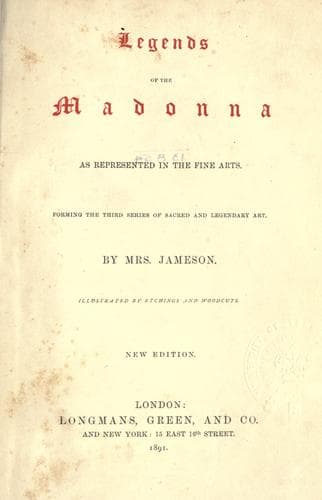
Legends of the Madonna as Represented in the Fine ArtsJameson, Mrs. (Anna)
Religion
Legends of the Madonna as Represented in the Fine Arts
Jameson, Mrs. (Anna)
Christian saints in art; Mary, Blessed Virgin, Saint -- Art; Mary, Blessed Virgin, Saint -- Legends
All these may be divided into Scriptural and Legendary
representations. The Scriptural scenes in which the Virgin Mary is a
chief or important personage, are the Annunciation, the Visitation,
the Nativity, the Purification, the Adoration of the Magi, the Flight
into Egypt, the Marriage at Cana, the Procession to Calvary, the
Crucifixion (as related by St. John), and the Descent of the Holy
Ghost. The Traditional and Legendary scenes are those taken from
the apocryphal Scriptures, some of which have existed from the third
century. The Legend of Joachim and Anna, the parents of the Virgin,
with the account of her early life, and her Marriage with Joseph,
down to the Massacre of the Innocents, are taken from the Gospel of
Mary and the Protevangelion. The scenes of the Flight into Egypt,
the Repose on the Journey, and the Sojourn of the Holy Family at
Hieropolis or Matarea, are taken from the Gospel of Infancy. The
various scenes attending the Death and Assumption of the Virgin are
derived from a Greek legendary poem, once attributed to St. John the
Evangelist, but the work, as it is supposed, of a certain Greek, named
Meliton, who lived in the ninth century, and who has merely dressed
up in a more fanciful form ancient traditions of the Church. Many
of these historical scenes have been treated in a devotional style,
expressing not the action, but the event, taken in the light of a
religious mystery; a distinction which I have fully explained in the
following pages, where I have given in detail the legends on which
these scenes are founded, and the religious significance conveyed by
the treatment.
A complete series of the History of the Virgin begins with the
rejection of her father Joachim from the temple, and ends with the
assumption and coronation, including most of the events in the History
of our Lord (as for example, the series painted by Giotto, in the
chapel of the Arena, at Padua); but there are many instances in which
certain important evens relating to the Virgin only, as the principal
person, are treated as a devotional series; and such are generally
found in the chapels and oratories especially dedicated to her. A
beautiful instance is that of the Death of the Virgin, treated in
a succession of scenes, as an event apart, and painted by Taddeo
Barrolo, in the Chapel of the Palazzo Publico, at Siena. This small
chapel was dedicated to the Virgin soon after the terrible plague of
1848 had ceased, as it was believed, by her intercession; so that
this municipal chapel was at once an expression of thanksgiving, and
a memorial of death, of suffering, of bereavement, and of hope in
the resurrection. The frescoes cover one wall of the chapel, and are
arranged in four scenes.
Public-domain text, read in full here on John Shaqi.
Reviews
Reviews
No reviews yet
Be the first to share your thoughts on this work.
Join the Discussion
Join the discussion
Sign in to leave a comment or review.
Sign InorCreate an account