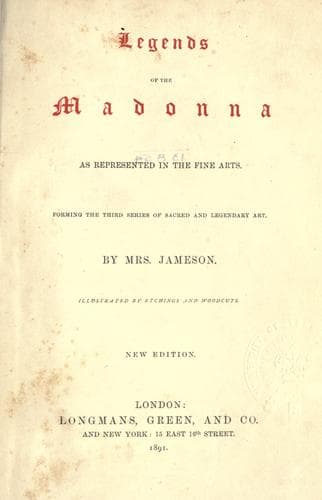
Legends of the Madonna as Represented in the Fine ArtsJameson, Mrs. (Anna)
Religion
Legends of the Madonna as Represented in the Fine Arts
Jameson, Mrs. (Anna)
Christian saints in art; Mary, Blessed Virgin, Saint -- Art; Mary, Blessed Virgin, Saint -- Legends
On the left hand (i.e. the right as we face the high altar) is the
History of the Virgin; on the opposite side, the History of St. John
the Baptist. The various cycles relating to St. John as patron of
Florence will be fully treated in the last volume of Legendary Art; at
present I shall confine myself to the beautiful set of subjects which
relate the history of the Virgin, and which the engravings of Lasinio
(see the "Ancient Florentine Masters") have rendered well known to
the lovers of art. They cover the whole wall and are thus arranged,
beginning from the lowest on the left hand.
1. Joachim is driven from the Temple.
2. The Birth of the Virgin.
3. The Presentation of the Virgin in the Temple.
4. The Marriage of Joseph and Mary.
5. The Adoration of the Magi (this is very much ruined).
6. The Massacre of the Innocents. (This also is much ruined.) Vasari
says it was the finest of all. It is very unusual to make this
terrible and pathetic scene part of the life of the Virgin.
7. In the highest and largest compartment, the Death and Assumption of
the Virgin.
Nearly contemporary with this fine series is that by Pinturicchio in
the Church of S. Maria del Popolo, at Rome (in the third chapel on the
right). It is comprised in five lunettes round the ceiling, beginning
with the Birth of the Virgin, and is remarkable for its elegance.
About forty years after this series was completed the people of Siena,
who had always bees remarkable for their devotion to the Virgin,
dedicated to Her honour the beautiful little chapel called the Oratory
of San Bernardino (v. Legends of the Monastic Orders), near the church
of San Francesco, and belonging to the same Order, the Franciscans.
This chapel is an exact parallelogram and the frescoes which cover
the four walls are thus arranged above the wainscot, which rises about
eight feet from the ground.
1. Opposite the door as we enter, the Birth of the Virgin. The usual
visitor to St. Anna is here a grand female figure, in voluminous
drapery. The delight and exultation of those who minister to the
new-born infant are expressed with the most graceful _naïveté_. This
beautiful composition should be compared with those of Ghirlandajo
and Andrea del Sarto in the Annunziata at Florence;[1] it yields to
neither as a conception and is wholly different. It is the work of a
Sienese painter little known--Girolamo del Pacchio.
[Footnote 1: This series, painted by Andrea and his scholars and
companions, Franciabigio and Pontormo, is very remarkable as a work of
art, but presents nothing new in regard to the choice and treatment of
the subjects.]
Public-domain text, read in full here on John Shaqi.
Reviews
Reviews
No reviews yet
Be the first to share your thoughts on this work.
Join the Discussion
Join the discussion
Sign in to leave a comment or review.
Sign InorCreate an account