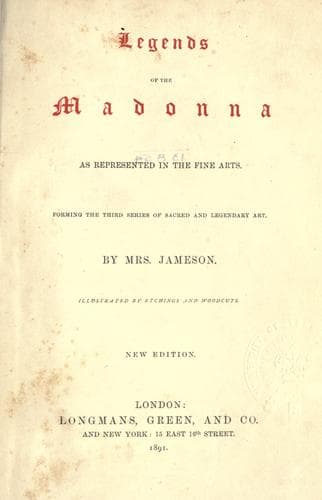
Legends of the Madonna as Represented in the Fine ArtsJameson, Mrs. (Anna)
Religion
Legends of the Madonna as Represented in the Fine Arts
Jameson, Mrs. (Anna)
Christian saints in art; Mary, Blessed Virgin, Saint -- Art; Mary, Blessed Virgin, Saint -- Legends
It appears therefore that the Life of the Virgin Mary, whether treated
as a devotional or historical series, forms a kind of pictured drama
in successive scenes; sometimes comprising only six or eight of the
principal events of her individual life, as her birth, dedication,
marriage, death, and assumption: sometimes extending to forty or fifty
subjects, and combining her history with that of her divine Son. I
may now direct the attention of the reader to a few other instances
remarkable for their beauty and celebrity.
Giotto, 1320. In the chapel at Padua styled _la Capella dell' Arena_.
One of the finest and most complete examples extant, combining the
Life of the Virgin with that of her Son. This series is of the highest
value, a number of scenes and situations suggested by the Scriptures
being here either expressed for the first time, or in a form unknown
in the Greek school.[1]
[Footnote 1: _Vide_ Kugler's Handbook, p. 129. He observes, that "the
introduction of the maid-servant spinning, in the story of St. Anna,
oversteps the limits of the higher ecclesiastical style." For an
explanation I must refer to the story as I have given it at p 249.
See, for the distribution of the subjects in this chapel, Lord
Lindsay's "Christian Art," vol. ii. A set of the subjects has since
been published by the Arundel Society.]
Angiolo Gaddi, 1380. The series in the cathedral at Prato. These
comprise the history of the Holy Girdle.
Andrea Orcagna, 1373. The beautiful series of bas-reliefs on the
shrine in Or-San-Michele, at Florence.
Nicolò da Modena, 1450. Perhaps the earliest engraved example:
very remarkable for the elegance of the _motifs_ and the imperfect
execution, engraving on copper being then a new art.
Albert Durer. The beautiful and well-known set of twenty-five
wood-cuts, published in 1510. A perfect example of the German
treatment.
Bernardino Luini, 1515. A series of frescoes of the highest beauty,
painted for the monastery Della Pace. Unhappily we have only the
fragments which are preserved in the Brera.
The series of bas-reliefs on the outer shrine of the Casa di Loretto,
by Sansovino, and others of the greatest sculptors of the beginning of
the sixteenth century.
The series of bas-reliefs round the choir at Milan: seventeen
subjects.
* * * * *
We often find the Seven Joys and the Seven Sorrows of the Virgin
treated as a series.
The Seven Joys are, the Annunciation, the Visitation, the Nativity,
the Adoration of the Magi, the Presentation in the Temple, Christ
found by his Mother, the Assumption and Coronation.
The Seven Sorrows are, the Prophecy of Simeon, the Flight into Egypt,
Christ lost by his Mother, the Betrayal of Christ, the Crucifixion
(with St. John and the Virgin only present), the Deposition from the
Cross, the Ascension when the Virgin is left on earth.
Public-domain text, read in full here on John Shaqi.
Reviews
Reviews
No reviews yet
Be the first to share your thoughts on this work.
Join the Discussion
Join the discussion
Sign in to leave a comment or review.
Sign InorCreate an account