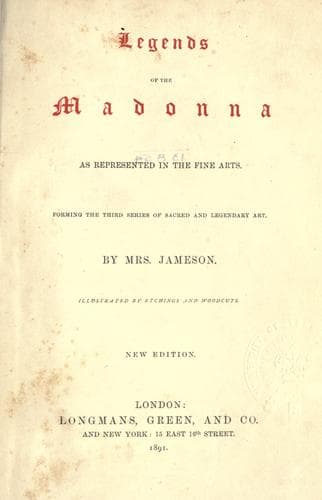
Legends of the Madonna as Represented in the Fine ArtsJameson, Mrs. (Anna)
Religion
Legends of the Madonna as Represented in the Fine Arts
Jameson, Mrs. (Anna)
Christian saints in art; Mary, Blessed Virgin, Saint -- Art; Mary, Blessed Virgin, Saint -- Legends
In the first edition of this work, only a passing allusion was made to
those female effigies, by some styled "_la donna orante_" (the Praying
Woman) and by others supposed to represent Mary the Mother of our
Lord, of which so many examples exist in the Catacombs and in the
sculptured groups on the ancient Christian sarcophagi. I know it has
long been a disputed, or at least an unsettled and doubtful point, as
to whether certain female figures existing on the earliest Christian
monuments were or were not intended to represent the Virgin Mary.
The Protestants, on the one hand, as if still inspired by that
superstition against superstition which led to the violent and vulgar
destruction of so many beautiful works of art, and the Catholics on
the other, jealous to maintain the authenticity of these figures as a
testimony to the ancient worship of the Virgin, both appear to me to
have taken an exaggerated and prejudiced view of a subject which ought
to be considered dispassionately on purely antiquarian and critical
grounds. Having had the opportunity, during a late residence in
Italy, of reconsidering and comparing a great number of these antique
representations, and having heard the opinions of antiquarians,
theologians, and artists, who had given their attention to the
subject, and who occasionally differed from each other as to the
weight of evidence, I have arrived at the conviction, that some of
these effigies represent the Virgin Mary, and others do not. I confess
I do not believe in any authentic representation of the Virgin holding
the Divine Child older than the sixth century, except when introduced
into the groups of the Nativity and the Worship of the Magi. Previous
to the Nestorian controversy, these maternal effigies, as objects of
devotion, were, I still believe, unknown, but I cannot understand
why there should exist among Protestants, so strong a disposition to
discredit every representation of Mary the Mother of our Lord to which
a high antiquity had been assigned by the Roman Catholics. We know
that as early as the second century, not only symbolical figures of
our Lord, but figures of certain personages of holy life, as St. Peter
and St. Paul, Agnes the Roman, and Euphemia the Greek, martyr, did
certainly exist. The critical and historical testimony I have given
elsewhere. (Sacred and Legendary Art.) Why therefore should there not
have existed effigies of the Mother of Christ, of the "Woman highly
blessed," the subject of so many prophecies, and naturally the object
of a tender and just veneration among the early Christians? It seams
to me that nothing could be more likely, and that such representations
ought to have a deep interest for all Christians, no matter of what
denomination--for _all_, in truth, who believe that the Saviour of
the world had a good Mother, His only earthly parent, who brought Him
forth, nurtured and loved Him. That it should be considered a point
Public-domain text, read in full here on John Shaqi.
Reviews
Reviews
No reviews yet
Be the first to share your thoughts on this work.
Elsewhere in the archive
Join the Discussion
Join the discussion
Sign in to leave a comment or review.
Sign InorCreate an account