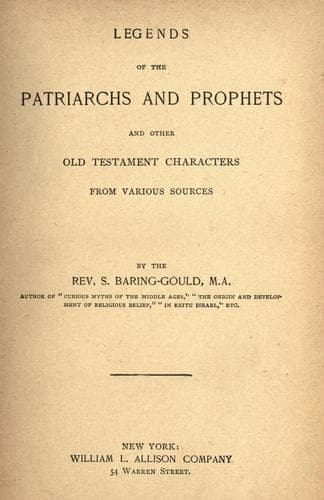
Legends of the Patriarchs and Prophets: And Other Old Testament Characters from Various SourcesBaring-Gould, S. (Sabine)
Religion
Legends of the Patriarchs and Prophets: And Other Old Testament Characters from Various Sources
Baring-Gould, S. (Sabine)
Bible. Old Testament -- Legends
After having governed many centuries, and knowing, by divine
revelation, that the time of his death drew nigh, he thus addressed
Surkrag: “I am about to depart hence and enter on another existence,
but before I leave, I wish to bequeath to you some famous work, which
shall perpetuate my name into remote ages.”
Thereupon Rocail erected an enormous sepulchre, adorned with statues
of various metals, made by talismanic art, which moved, and spake, and
acted like living men.[143]
According to the Rabbinic traditions, Seth was one of the thirteen who
came circumcised into the world. The rest were Adam, Enoch, Noah, Shem,
Terah, Jacob, Joseph, Moses, Samuel, David, Isaiah, and Jeremiah.[144]
The book Schene Luchôth says that the soul of righteous Abel passed
into the body of Seth, and afterwards this same soul passed into Moses;
thus the law, which was known to Adam and in which Abel had been
instructed, was not new to Moses.[145]
The Little Genesis says, that Seth was instructed by the angels in what
was to take place in the world; how its iniquity was to grow, and a
flood was to overwhelm it; and how the Messiah would come and restore
all things. Seth was remarkable for the majesty and beauty of his
appearance, as he had inherited much of the loveliness of unfallen man.
He married his sister Azur, or, according to others, Noræa or Horæa.
Suidas under the heading ‘Σήδ,’ says: “Seth was the son of Adam: of
this it is said, the sons of God went in unto the daughters of men;
that is to say, the sons of Seth went in unto the daughters of Cain.
For in that age Seth was called God, because he had discovered Hebrew
letters, and the names of the stars; but especially on account of his
great piety, so that he was the first to bear the name of God.”
Theodoret thus refers to the verse,--“_And to Seth, to him also there
was born a son; and he called his name Enos; then began men to call
upon the name of the Lord_,” or as our marginal reading is, “_then
began men to call themselves by the name of the Lord_:” “Aquila
interpreted it thus, ‘then Seth began to be called by the name of the
Lord.’ These words intimate his piety, which deserved that he should
receive the sacred name; and he was called God by his acquaintance,
and his children were termed the sons of God, just as we are called
Christians after Christ.”[146]
The origin of this tradition seems to be the fact that Seth was the
name of an ancient Egyptian deity, at first regarded as the giver of
light and civilization, but afterwards identified with Typhon by
the Egyptians, who considered Seth to be the chief god of the Hyksos
or shepherd kings; and in their hatred of these oppressors, the name
of Seth was every where obliterated on their monuments, and he was
regarded as one with the great adversary, Typhon; and was represented
as an ass, or with an ass’s head.[147]
Public-domain text, read in full here on John Shaqi.
Reviews
Reviews
No reviews yet
Be the first to share your thoughts on this work.
Elsewhere in the archive
Join the Discussion
Join the discussion
Sign in to leave a comment or review.
Sign InorCreate an account