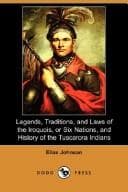
Legends, Traditions, and Laws of the Iroquois, or Six Nations, and History of the Tuscarora IndiansJohnson, Elias
History
Legends, Traditions, and Laws of the Iroquois, or Six Nations, and History of the Tuscarora Indians
Johnson, Elias
Iroquois Indians; Tuscarora Indians
"Some of the Tuscarora chiefs have lately been with Governor Spotswood,
of Virginia, and pretend a great inclination to peace.
"They are again to be with him on the 26th of this month; we are to send
two agents to meet them there--Mr. Tobias Knight and Mayor Christophe
Gale--not with any expectation that the Governor will make any treaty for
us, for that would be dishonorable to your lordship and make us appear
contemptible in the eyes of the Indians, but with a view to hear what
they have to propose."
I might quote many more passages similar to those above, but let these
few suffice to show how the Tuscaroras were treated. Now, finally, with a
combination of causes, they were in 1713, crushed and broken down as a
nation, to satisfy the inclinations of the white people, persecutions
being kept up by neighboring whites and southern Indians until June
following. The Oneida Indians, having heard of the disaster to the
Tuscarora Nation, invited them to come and make their dwelling among
them: so, accordingly, they left Carolina and took their journey north to
rejoin their sister nations.
Methink I can see them leaving their once cherished homes--the aged, the
helpless, the women and children, and the warriors faint and few--the
ashes are cold on their native hearth; the smoke no more curls round
their lowly cabin: they move on with slow, unsteady steps; they turn to
take a last look upon their doomed village and cast a last glance upon
the long cherished memories of their fathers' graves. They shed no tears;
they utter no cries: they heave no groans, they linger but a moment. They
know and feel that there is for them still one more remove further, not
distant nor unseen.
One bright, sunny June morning, in the year 1813, was one of the darkest
days that the Tuscaroras ever witnessed, when most of the nation took
their pace to the north until they came within the bounds of the Oneida
domain, about two miles west of Tamaqua, in the state of Pennsylvania,
where they located and set out apple trees which can be seen to this day:
some of the trees, will measure about two feet in diameter. Here they
dwelled for about two years.
In about the year 1815, the Iroquois, being the Mohawk, Onondaga, Seneca,
Oneida and Cayuga nations, which were then called the five nations, had a
general council where the Tuscarora made an application through their
brothers the Oneida, to be admitted into the Iroquois and become the
sixth nation, on the grounds of a common generic origin, which was
granted them unanimously. Then the Seneca adopted the Tuscarora as their
children. Ever since that time to the present, if a Seneca addresses the
Tuscaroras, he will invariably salute them as "my sons," in social or in
council; and also the Tuscaroras in return will say "my fathers." The
relation has always been kept up to the present.
Public-domain text, read in full here on John Shaqi.
Reviews
Reviews
No reviews yet
Be the first to share your thoughts on this work.
Join the Discussion
Join the discussion
Sign in to leave a comment or review.
Sign InorCreate an account