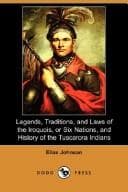
Legends, Traditions, and Laws of the Iroquois, or Six Nations, and History of the Tuscarora IndiansJohnson, Elias
History
Legends, Traditions, and Laws of the Iroquois, or Six Nations, and History of the Tuscarora Indians
Johnson, Elias
Iroquois Indians; Tuscarora Indians
The Tuscaroras were then initiated without enlarging the frame-work of
the confederacy and formation of the League, by allowing them their own
Sachems and Chiefs, which they had as hereditary from their nation in the
south, except on which they gave, as the Holder of the Tree, to sit and
enjoy a nominal equality in the councils of the League, by the courtesy
of the other five nations. They were not dependent, but were admitted to
as full an equality as could be granted them without enlarging the frame-
work of the confederacy. In the councils of the League they had no
national designation. They were then assigned a portion of the Oneidas'
territory, which is lying upon the Unadilla river on the east, the
Chenango on the west, and the Susquehanna on the south, where they
dwelled and enjoyed their peace again for about seventy years. In 1736
they numbered 200 warriors of fighting men.
We again hear of the Tuscarora by history, concerning a massacre of the
German Flats, N. Y., in November, 1757.
A narrative communicated to the author of the Documentary History of New
York, vol. 2, page 520, viz: A few days after this massacre and
desolation had been perpetrated, Sir William Johnson dispatched Geo.
Croghan, Esq., Deputy Agent, with Mr. Montour, the Indian interpreter, to
the German Flats, where he understood several of the Oneida and Tuscarora
Indians were assembled, in order to call upon them to explain why they
had not given more timely notice to the Germans of the designs and
approach of the enemy, it having been reported that no intelligence had
been given by the Indians until the same morning the attack was made, and
as these Indians might naturally be supposed, from their situation and
other circumstances, to have had an earlier knowledge of the enemy's
design and march.
Before Mr. Croghan could get up to the German Flats the aforesaid Indians
were on their road homewards, but he was informed that the Chief Sachem
of the Upper Oneida town, with a Tuscarora Sachem (which is supposed to
be Solomon Longboard) and another Oneida Indian, were still about four
miles from Fort Harkeman, upon which he sent a messenger to acquaint them
that he was at the said fort.
The aforesaid Indians returned, and on the 3oth of November, at Fort
Harkeman, Conaghquieson, the Oneida Sachem, made the following speech to
Mr. Croghan, having first called in one Rudolph Shumaker, Hanjost Harkman
and several other Germans who understood the Indian language, and desired
them to sit down and hear what he had to say. Conaghquieson then
proceeded and said:
"Brothers:--I can't help telling you that we were very much surprised to
hear that our English brethren suspect and charge us with not giving them
timely notice of the designs of the French, as it is well known we have
not neglected to give them every piece of intelligence that came to our
knowledge.
Public-domain text, read in full here on John Shaqi.
Reviews
Reviews
No reviews yet
Be the first to share your thoughts on this work.
Join the Discussion
Join the discussion
Sign in to leave a comment or review.
Sign InorCreate an account