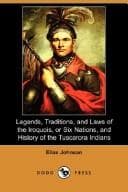
Legends, Traditions, and Laws of the Iroquois, or Six Nations, and History of the Tuscarora IndiansJohnson, Elias
History
Legends, Traditions, and Laws of the Iroquois, or Six Nations, and History of the Tuscarora Indians
Johnson, Elias
Iroquois Indians; Tuscarora Indians
The Oneida being the original owner of the tract of land assigned to the
Tuscarora as aforesaid, were made party with the Tuscarora to the treaty
made at Fort Herkimer in the year 1785, by which it was ceded to the
State, and the Oneida took all the avails of the treaty. The Tuscaroras
were then again left without a home and were partially scattered among
the other nations, although they continued to preserve their nationality.
They had some settlements, at a later period, in Oneida Castle, called by
them Gaunea-wahro-hare (signifying head on the pole), and one in the
valley of the Genesee below Avon, called by them Ju-na-stre-yo
(signifying the beautiful valley); another settlement at Con-na-so-ra-ga,
on the line between Onondaga and Oneida; another in the fork of
Chattenango Creek, which they called Ju-ta-nea-ga (signifying where the
sun shines); and another on the Jordan Creek, which they called Kan-ha-to
(signifying limb in water). These several places were settled at
different periods, which I am not able to give.
In the revolutionary war between the United States and Great Britain, the
Tuscaroras then had their settlement at the place alotted them by the
league in 1715, between the Unadilla river and the Chenango. They took an
active part with the United States. Many a soldier and scout of the
United States, in their fatigue and hunger, found a rest and a morsel in
the rude homes of the Tuscaroras, which were ever hospitably open to
them.
When the other Indians which took part with the British knew that the
Tuscaroras took part with the United States, they invaded their
settlement, destroyed their property and burned down their houses to
ashes, which scattered them for a while. There was a party that settled
at Oyouwayea, or Johnson's landing place, on lake Ontario, about four
miles east of the mouth of Niagara River, which is at the mouth of the
four-mile creek, for the purpose of getting out of the centre of the
other Indians which were for the British.
Public-domain text, read in full here on John Shaqi.
Reviews
Reviews
No reviews yet
Be the first to share your thoughts on this work.
Join the Discussion
Join the discussion
Sign in to leave a comment or review.
Sign InorCreate an account