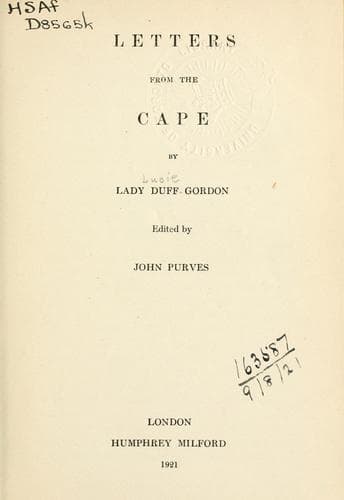
Cape of Good Hope (South Africa) -- Description and travel
I made friends here the other day with a lively dried-up little old
Irishman, who came out at seven years old a pauper-boy. He has made a
fortune by ‘going on _Togt_’ (_German_, _Tausch_), as thus; he charters
two waggons, twelve oxen each, and two Hottentots to each waggon, leader
and driver. The waggons he fills with cotton, hardware, &c., &c.—an
ambulatory village ‘shop’,—and goes about fifteen miles a day, on and on,
into the far interior, swapping baftas (calico), punjums (loose
trowsers), and voerschitz (cotton gownpieces), pronounced ‘foossy’,
against oxen and sheep. When all is gone he swaps his waggons against
more oxen and a horse, and he and his four ‘totties’ drive home the
spoil; and he has doubled or trebled his venture. _En route_ home, each
day they kill a sheep, and eat it _all_. ‘What!’ says I; ‘the whole?’
‘Every bit. I always take one leg and the liver for myself, and the
totties roast the rest, and melt all the fat and entrails down in an iron
pot and eat it with a wooden spoon.’ _Je n’en revenais pas_. ‘What! the
whole leg and liver at one meal?’ ‘Every bit; ay, and you’d do the same,
ma’am, if you were there.’ No bread, no salt, no nothing—mutton and
water. The old fellow was quite poetic and heroic in describing the joys
and perils of Togt. I said I should like to go too; and he bewailed
having settled a year ago in a store at Swellendam, ‘else he’d ha’ fitted
up a waggon all nice and snug for me, and shown me what going on togt was
like. Nothing like it for the health, ma’am; and beautiful shooting.’
My friend had 700_l._ in gold in a carpet bag, without a lock, lying
about on the stoep. ‘All right; nobody steals money or such like here.
I’m going to pay bills in Capetown.’
Tell my mother that a man would get from 2_l._ to 4_l._ a month wages,
with board, lodging, &c., all found, and his wife from 1_l._ 10_s._ to
2_l._ a month and everything found, according to abilities and
testimonials. Wages are enormous, and servants at famine price; emigrant
ships are _cleared off_ in three days, and every ragged Irish girl in
place somewhere. Four pounds a month, and food for self, husband, and
children, is no uncommon pay for a good cook; and after all her cookery
may be poor enough. My landlady at Capetown gave that. The housemaid
had _only_ 1_l._ 5_s._ a month, but told me herself she had taken 8_l._
in one week in ‘tips’. She was an excellent servant. Up country here
the wages are less, but the comfort greater, and the chances of ‘getting
on’ much increased. But I believe Algoa Bay or Grahamstown are by far
the best fields for new colonists, and (I am assured) the best climate
for lung diseases. The wealthy English merchants of Port Elizabeth
(Algoa Bay) pay best. It seems to me, as far as I can learn, that every
really _working_ man or woman can thrive here.
Public-domain text, read in full here on John Shaqi.
Reviews
Reviews
No reviews yet
Be the first to share your thoughts on this work.
Join the Discussion
Join the discussion
Sign in to leave a comment or review.
Sign InorCreate an account