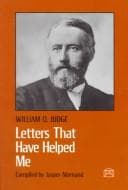
Judge, William Quan, 1851-1896; Theosophists -- United States -- Correspondence; Theosophy
The proper function of the Guru is to readjust, and not to pour in vast
masses of knowledge expressed in clear and easily comprehended terms.
The latter would be a piece of nonsense, however agreeable, and not any
whit above what any well-written book would do for its reader.
The faith and love which exist between them act as a stimulus to both,
and as a purifier to the mind of the chela.
But if the chela, after a while, meets another person who seems to know
as much as his "little guru," and to express it in very easy terms, and
the chela determines to take him as a teacher, he commits an error.
He may listen to his teaching and admire and profit by it, but the
moment he mentally determines and then in words asks the other to be
his teacher, he begins to rupture the bond that was just established,
and possibly may lose altogether the benefit of both. Not necessarily,
however; but certainly, if he acquaints not his "little guru" with the
fact of the new adoption of teacher, there will be much confusion in
that realm of being wherein both do their real "work"; and when he does
acquaint his "little guru" with the fact of the newly-acquired teacher,
that older guru will retire.
None of this is meant for those minds which do not regard these matters
as sacred. A Guru is a sacred being in that sense. Not, of course, in a
general sense--yet even if so regarded _when worthy_ it is better for
the chela,--but in all that pertains to the spiritual and real life. To
the high-strung soul this is a matter of _adoption_; a most sacred and
valuable thing, not lightly taken up or lightly dropped. For the Guru
becomes for the time the spiritual _Father_ of the chela; that one who is
destined to bring him into life or to pass him on to Him who will do so.
So as the Guru is the _adjuster_ in reality, the chela does not--except
where the Guru is known to be a great Sage or where the chela does it
by nature--give slavish attention to every word. He hears the word
and endeavors to assimilate the meaning underneath; and if he cannot
understand he lays it aside for a better time, while he presently
endeavors to understand what he can. And if even--as is often so in
India--he cannot understand at all, he is satisfied to be near the
Guru and do what may properly be done for him; for even then his
abiding faith will eventually clear his mind, of which there are many
examples, and regarding which how appropriate is the line:
"They also serve who only stand and wait."
Z.
XIV.
DEAR JASPER:
What I wrote in my last is what may be properly said to earnest
inquirers who show by their perseverance that they are not mere idle
curiosity-seekers, desirous of beguiling the tedium of life with new
experiments and sensations. It is not _what_ is done, but the spirit in
which the least thing is done for Them who are all, that is counted.
Public-domain text, read in full here on John Shaqi.
Reviews
Reviews
No reviews yet
Be the first to share your thoughts on this work.
Join the Discussion
Join the discussion
Sign in to leave a comment or review.
Sign InorCreate an account