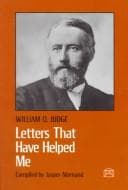
Judge, William Quan, 1851-1896; Theosophists -- United States -- Correspondence; Theosophy
In further illustration of this letter, I might cite the case of a
friend of mine who was at once fired with Theosophy on first hearing
of it and ardently desired to become a chela. Certainly he had
known these truths in other lives, for all seemed familiar to him,
and, though he was what is called "a man of the world," he accepted
the philosophy, measured some of its possibilities intuitively, and
while careful to do his duty and cause no jars, he ranged his life,
especially his inner life, to suit these views. The question of
chelaship assumed great prominence in his mind. He knew of no chelas;
knew not where to knock or whom to ask. Reflection convinced him that
real chelaship consisted in the inner attitude of the postulant; he
remembered magnetic and energetic laws, and he said to himself that he
could at will constitute himself a chela to the Law, at least so far as
his own attitude went, and if this did not satisfy him, it was a proof
that he desired some personal reward, satisfaction, or powers in the
matter, and that his motive was not pure. He was slow to formulate his
desires, even to his own mind, for he would not lightly make demands
upon the Law; but he at last determined to put his own motives to the
test; to try himself and see if he could stand in the attitude of a
faithful chela, unrecognized and apparently unheard. He then recorded
in his own mind an obligation to serve Truth and the Law as a chela
should, always seeking for light and for further aid if possible,
recognizing meanwhile that the obligation was on his side only, and
that he had no claims on Masters, and only such as he himself could by
the strength of his own purpose institute upon the Law. Wherever he
could hear of chelas and their duties he listened or read; he tried to
imagine himself in the position of an accepted chela, and to fill, so
far as in him lay, the duties of that place, living up to all the light
he had. For he held that a disciple should always think and act towards
the highest possibilities, whether or not he had yet attained these,
and not merely confine himself to that course of action which might be
considered suited to his lower class or spiritual estate. He believed
that the heart is the creator of all real ties, and it alone. To raise
himself by himself was then his task. This attitude he resolved to
maintain life after life, if needs were, until at last his birthright
should be assured, his claim recognized by the Law.
Public-domain text, read in full here on John Shaqi.
Reviews
Reviews
No reviews yet
Be the first to share your thoughts on this work.
Elsewhere in the archive
Join the Discussion
Join the discussion
Sign in to leave a comment or review.
Sign InorCreate an account