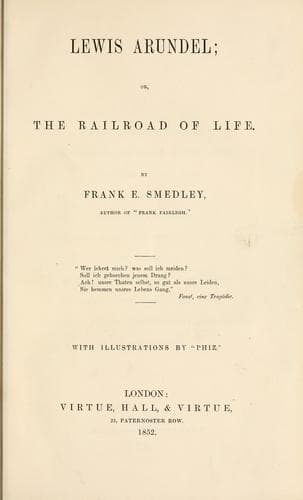
Lewis Arundel; Or, The Railroad Of LifeSmedley, Frank E. (Frank Edward)
General
Lewis Arundel; Or, The Railroad Of Life
Smedley, Frank E. (Frank Edward)
English fiction -- 19th century
This young lady, being such as we have described her, tripped lightly
across the apartment till she had stationed herself behind her cousin
Charles, and perceiving that both gentlemen were so preoccupied as not
to have observed her approach, contrived, by standing on tiptoe and
peeping over Leicester’s shoulder, to witness the introduction of the
cow of which we have already made honourable mention.
During the animated discussion on the tail question she nearly betrayed
her presence by laughing outright; repressing the inclination, however,
she retraced her steps, and had nearly succeeded in reaching the side
door by which she had entered, when her habit, catching against a table,
caused the overthrow of a piece of ornamental china and revealed her
presence.
On hearing the sound, Lewis, recalled to a sense of his situation, and
for the first time struck by the idea that, in touching the drawing, he
had been guilty of an unwarrantable liberty, rose hastily from his seat,
colouring crimson as he did so, from an agreeable mixture of shyness,
mortification, and proud self-reproach. Leicester, on the other hand,
with the _à-plomb_ and presence of mind of a man of the world, turned
leisurely, and whispering, “Keep your own counsel, there’s no harm
done,” he advanced towards his cousin, saying with a nonchalant air,
“You have stolen a march upon us, Annie. This gentleman and I called to
see the General upon business, and as he seems resolved to afford us a
practical lesson on the virtue of patience. I ventured to while away the
time by showing my friend some of your sketches. By the way, let me
introduce you. My cousin, Miss Grant--Mr. Arundel.” Thus invoked, Lewis,
who in order to atone to his wounded self-respect, had wrapped himself
in his very coldest and haughtiest manner, and resembled a banished
prince rather than an every-day Christian, advanced a few steps and
acknowledged the introduction by a most Grandisonian inclination of the
head.
The lady performed her part of the ceremony with an easy courtesy, into
which perhaps an equal degree of hauteur was infused, although not the
slightest effort was visible.
“Mr. Arundel is doubtless a judge of painting, and my poor sketches are
by no means calculated to bear severe criticism,” remarked Miss Grant
demurely.
As Lewis remained silent, Leicester hastened to reply: “A judge! of
course he is; he’s just returned from Germany, the happy land where
smoking, singing, and painting all come by nature.”
“Indeed!” returned Miss Grant. “Then, if it is not too troublesome,
perhaps I might ask Mr. Arundel’s advice as to a sketch of Broadhurst
I was attempting before your arrival; I left off in despair, because I
could not manage anything for the foreground.”
“Try an elephant,” suggested Leicester; “it would have a grand effect,
besides possessing the advantage of novelty, and filling up lots of
space.”
“Would you bring me the drawing, Charles?” returned his cousin.
Public-domain text, read in full here on John Shaqi.
Reviews
Reviews
No reviews yet
Be the first to share your thoughts on this work.
Join the Discussion
Join the discussion
Sign in to leave a comment or review.
Sign InorCreate an account