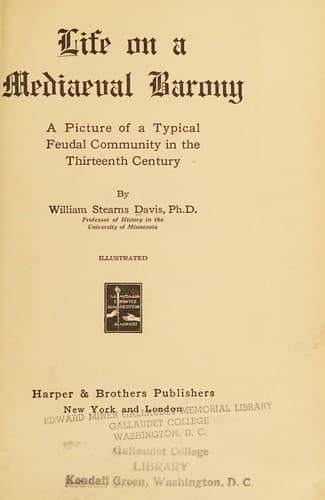
Life on a Mediaeval Barony: A Picture of a Typical Feudal Community in the Thirteenth CenturyDavis, William Stearns
History
Life on a Mediaeval Barony: A Picture of a Typical Feudal Community in the Thirteenth Century
Davis, William Stearns
Chivalry; Civilization, Medieval; Feudalism
Nevertheless the chatelaines and baronesses of these parts are not
always meek doves at the mercy of their husbands. Are they not sprung
themselves from a domineering stock? Are they not reared around a
castle, which is a great barrack, and where the talk is ever of feuds
and forays, horses, lances, and armor? Many a noble lady can answer
her husband's fist with a rousing box on the ear, and, if he is not
a courageous man, make him quail and surrender before her passions.
Her habits are likely to seem very masculine. If she can quarrel like
a virago, she can also prove a she-wolf in times of danger. A knight
will ride away to the wars, leaving his castle under the command of his
wife and feel certain that it will be defended to the inner donjon. The
rough men at arms will obey her orders as implicitly as her husband's.
In short, the feudal noblewoman is, as might be expected, a compound
of mortal weaknesses and excellencies, but all of these qualities are
somewhat naïve and elemental.
In any case the castle women cannot complain of being shut up in a
harem. They have perfect freedom to meet strange men. If we accept the
epic poems, when noble maidens believe a visiting knight to be very
handsome they do not hesitate to tell him so to his face. In many love
stories the first advances come from the lady, and not infrequently
these advances are rather coldly received by the knight. Your average
mail-clad cavalier is a man of strong passions, but he is often more
interested in war and the chase than in fair maidens. He is seldom a
philanderer.
[Sidenote: Grossness of Castle Life]
If we visited the castles around St. Aliquis and listened to typical
jongleurs' tales, we should gather abundant material for monkish
preachments. Noble ladies are said to make few difficulties about
inviting male visitors to their chambers to sit on their beds while
they are still within the same--or entering the room of a male guest
and sitting on _his_ bed while conversing very familiarly. Women often
meet strangers in scandalously insufficient garments. Ladies also
talk with the uttermost freedom to men, quite as openly as young men
will talk on ticklish matters among themselves. Many a story, jesting
question, or "gab" which is utterly coarse, not to say worse, will be
exchanged in mixed company. Young women are seldom well chaperoned. In
place of the duenna there is the "waiting woman," herself apt to have
her own lover and ready to help her mistress push matters with hers.
If there is a sensual intrigue, all criticism ceases if there is, at
the end, a formal marriage; but many romances (according to the current
stories) in no wise end in marriages. A wedding is by no means the
standard climax even to a happy love affair.
Public-domain text, read in full here on John Shaqi.
Reviews
Reviews
No reviews yet
Be the first to share your thoughts on this work.
Elsewhere in the archive
Join the Discussion
Join the discussion
Sign in to leave a comment or review.
Sign InorCreate an account