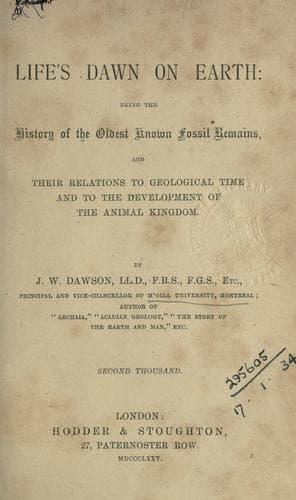
Life's Dawn on Earth: Being the history of the oldest known fossil remains, and their relations to geological time and to the development of the animal kingdomDawson, John William, Sir
History
Life's Dawn on Earth: Being the history of the oldest known fossil remains, and their relations to geological time and to the development of the animal kingdom
Dawson, John William, Sir
Life -- Origin; Paleontology -- Precambrian
"The specimens first mentioned are masses, often several inches in
diameter, presenting to the naked eye alternate laminæ of serpentine,
or of pyroxene, and carbonate of lime. Their general aspect, as
remarked by Sir W. E. Logan (_Geology of Canada_, 1863, p. 49),
reminds the observer of that of the Silurian corals of the genus
Stromatopora, except that the laminæ diverge from and approach each
other, and frequently anastomose or are connected by transverse septa.
"Under the microscope the resemblance to Stromatopora is seen to
be in general form merely, and no trace appears of the radiating
pillars characteristic of that genus. The laminæ of serpentine and
pyroxene present no organic structure, and the latter mineral is
highly crystalline. The laminæ of carbonate of lime, on the contrary,
retain distinct traces of structures which cannot be of a crystalline
or concretionary character. They constitute parallel or concentric
partitions of variable thickness, enclosing flattened spaces or
chambers, frequently crossed by transverse plates or septa, in some
places so numerous as to give a vesicular appearance, in others
occurring only at rare intervals. The laminæ themselves are excavated
on their sides into rounded pits, and are in some places traversed by
canals, or contain secondary rounded cells, apparently isolated. In
addition to these general appearances, the substance of the laminæ,
where most perfectly preserved, is seen to present a fine granular
structure, and to be penetrated by numerous minute tubuli, which
are arranged in bundles of great beauty and complexity, diverging
in sheaf-like forms, and in their finer extensions anastomosing so
as to form a network (figs. 10 and 28). In transverse sections, and
under high powers, the tubuli are seen to be circular in outline, and
sharply defined (fig. 29). In longitudinal sections, they sometimes
present a beaded or jointed appearance. Even where the tubular
structure is least perfectly preserved, traces of it can still be
seen in most of the slices, though there are places in which the
laminæ are perfectly compact, and perhaps were so originally.
"With respect to the nature and probable origin of the appearances
above described, I would make the following remarks:--
Public-domain text, read in full here on John Shaqi.
Reviews
Reviews
No reviews yet
Be the first to share your thoughts on this work.
Join the Discussion
Join the discussion
Sign in to leave a comment or review.
Sign InorCreate an account