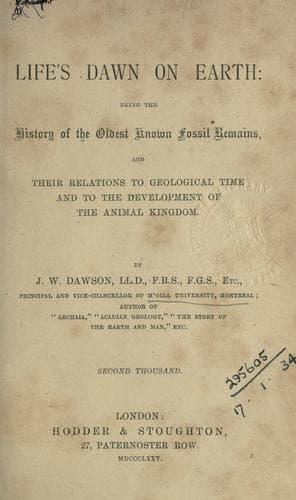
Life's Dawn on Earth: Being the history of the oldest known fossil remains, and their relations to geological time and to the development of the animal kingdomDawson, John William, Sir
History
Life's Dawn on Earth: Being the history of the oldest known fossil remains, and their relations to geological time and to the development of the animal kingdom
Dawson, John William, Sir
Life -- Origin; Paleontology -- Precambrian
"1. The serpentine and pyroxene which fill the cavities of the
calcareous matter have no appearance of concretionary structure.
On the contrary, their aspect is that of matter introduced by
infiltration, or as sediment, and filling spaces previously existing.
In other words, the calcareous matter has not been moulded on the
forms of the serpentine and augite, but these have filled spaces
or chambers in a hard calcareous mass. This conclusion is further
confirmed by the fact, to be referred to in the sequel, that the
serpentine includes multitudes of minute foreign bodies, while the
calcareous matter is uniform and homogeneous. It is also to be
observed that small veins of carbonate of lime occasionally traverse
the specimen's, and in their entire absence of structures other than
crystalline, present a striking contrast to the supposed fossils.
"2. Though the calcareous laminæ have in places a crystalline
cleavage, their forms and structures have no relation to this. Their
cells and canals are rounded, and have smooth walls, which are
occasionally lined with films apparently of carbonaceous matter.
Above all, the minute tubuli are different from anything likely to
occur in merely crystalline calc-spar. While in such rocks little
importance might be attached to external forms simulating the
appearances of corals, sponges, or other organisms, these delicate
internal structures have a much higher claim to attention. Nor is
there any improbability in the preservation of such minute parts in
rocks so highly crystalline, since it is a circumstance of frequent
occurrence in the microscopic examination of fossils that the finest
structures are visible in specimens in which the general form and the
arrangement of parts have been obliterated. It is also to be observed
that the structure of the calcareous laminæ is the same, whether the
intervening spaces are filled with serpentine or with pyroxene.
"3. The structures above described are not merely definite and
uniform, but they are of a kind proper to animal organisms, and
more especially to one particular type of animal life, as likely as
any other to occur under such circumstances: I refer to that of the
Rhizopods of the order Foraminifera. The most important point of
difference is in the great size and compact habit of growth of the
specimens in question; but there seems no good reason to maintain
that Foraminifera must necessarily be of small size, more especially
since forms of considerable magnitude referred to this type are known
in the Lower Silurian. Professor Hall has described specimens of
Receptaculites twelve inches in diameter; and the fossils from the
Potsdam formation of Labrador, referred by Mr. Billings to the genus
Archæocyathus, are examples of Protozoa with calcareous skeletons
scarcely inferior in their massive style of growth to the forms now
under consideration.
Public-domain text, read in full here on John Shaqi.
Reviews
Reviews
No reviews yet
Be the first to share your thoughts on this work.
Join the Discussion
Join the discussion
Sign in to leave a comment or review.
Sign InorCreate an account