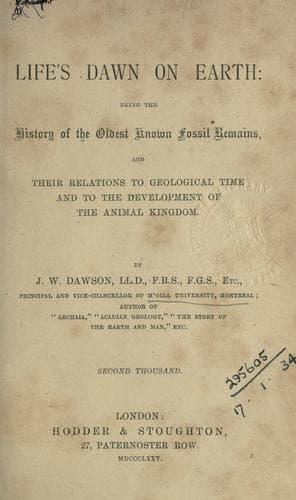
Life's Dawn on Earth: Being the history of the oldest known fossil remains, and their relations to geological time and to the development of the animal kingdomDawson, John William, Sir
History
Life's Dawn on Earth: Being the history of the oldest known fossil remains, and their relations to geological time and to the development of the animal kingdom
Dawson, John William, Sir
Life -- Origin; Paleontology -- Precambrian
"The careful examination which I have made, in accordance with
the request you were good enough to convey to me from Dr. Dawson
and to second on your own part, with the structure of the very
extraordinary fossil which you have brought from the Laurentian
rocks of Canada,[Q] enables me most unhesitatingly to confirm the
sagacious determination of Dr. Dawson as to its Rhizopod characters
and Foraminiferal affinities, and at the same time furnishes new
evidence of no small value in support of that determination. In
this examination I have had the advantage of a series of sections
of the fossil much superior to those submitted to Dr. Dawson; and
also of a large series of decalcified specimens, of which Dr. Dawson
had only the opportunity of seeing a few examples after his memoir
had been written. These last are peculiarly instructive; since
in consequence of the complete infiltration of the chambers and
canals, originally occupied by the sarcode-body of the animal, by
mineral matter insoluble in dilute nitric acid, the removal of the
calcareous shell brings into view, not only the internal casts of
the chambers, but also casts of the interior of the 'canal system'
of the 'intermediate' or 'supplemental skeleton,' and even casts of
the interior of the very fine parallel tubuli which traverse the
proper walls of the chambers. And, as I have remarked elsewhere,[R]
'such casts place before us far more exact representations of the
configuration of the animal body, and of the connections of its
different parts, than we could obtain even from living specimens by
dissolving away their shells with acid; its several portions being
disposed to heap themselves together in a mass when they lose the
support of the calcareous skeleton.'
[Footnote Q: The specimens submitted to Dr. Carpenter were taken from a
block of Eozoon rock, obtained in the Petite Nation seigniory, too late
to afford Dr. Dawson an opportunity of examination. They are from the
same horizon as the Grenville specimens.--W. E. L.]
[Footnote R: _Introduction to the Study of the Foraminifera_, p. 10.]
"The additional opportunities I have thus enjoyed will be found,
I believe, to account satisfactorily for the differences to be
observed between Dr. Dawson's account of the Eozoon and my own. Had
I been obliged to form my conclusions respecting its structure only
from the specimens submitted to Dr. Dawson, I should very probably
have seen no reason for any but the most complete accordance with
his description: while if Dr. Dawson had enjoyed the advantage of
examining the entire series of preparations which have come under my
own observation, I feel confident that he would have anticipated the
corrections and additions which I now offer.
Public-domain text, read in full here on John Shaqi.
Reviews
Reviews
No reviews yet
Be the first to share your thoughts on this work.
Elsewhere in the archive
Join the Discussion
Join the discussion
Sign in to leave a comment or review.
Sign InorCreate an account