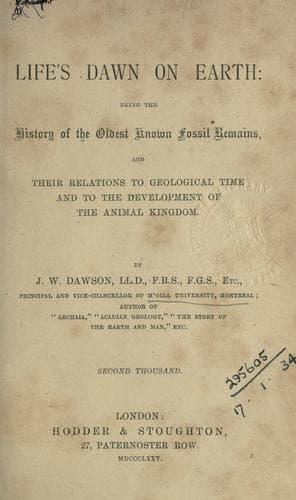
Life's Dawn on Earth: Being the history of the oldest known fossil remains, and their relations to geological time and to the development of the animal kingdomDawson, John William, Sir
History
Life's Dawn on Earth: Being the history of the oldest known fossil remains, and their relations to geological time and to the development of the animal kingdom
Dawson, John William, Sir
Life -- Origin; Paleontology -- Precambrian
"The mode in which each successive layer originates from the one
which had preceded it, is a question to which my attention has been
a good deal directed; but I do not as yet feel confident that I
have been able to elucidate it completely. There is certainly no
regular system of apertures for the passage of stolons giving origin
to new segments, such as are found in all ordinary Polythalamous
Foraminifera, whether their type of growth be rectilinear, spiral,
or cyclical; and I am disposed to believe that where one layer is
separated from another by nothing else than the proper walls of
the chambers,--which, as I shall presently show, are traversed by
multitudes of minute tubuli giving passage to pseudopodia,--the
coalescence of these pseudopodia on the external surface would
suffice to lay the foundation of a new layer of sarcodic segments.
But where an intermediate or supplemental skeleton, consisting of a
thick layer of solid calcareous shell, has been deposited between
two successive layers, it is obvious that the animal body contained
in the lower layer of chambers must be completely cut off from
that which occupies the upper, unless some special provision exist
for their mutual communication. Such a provision I believe to have
been made by the extension of bands of sarcode, through canals left
in the intermediate skeleton, from the lower to the upper tier of
chambers. For in such sections as happen to have traversed thick
deposits of the intermediate skeleton, there are generally found
passages distinguished from those of the ordinary canal-system by
their broad flat form, their great transverse diameter, and their
non-ramification. One of these passages I have distinctly traced
to a chamber, with the cavity of which it communicated through two
or three apertures in its proper wall; and I think it likely that
I should have been able to trace it at its other extremity into a
chamber of the superjacent tier, had not the plane of the section
passed out of its course. Riband-like casts of these passages are
often to be seen in decalcified specimens, traversing the void spaces
left by the removal of the thickest layers of the intermediate
skeleton.
Public-domain text, read in full here on John Shaqi.
Reviews
Reviews
No reviews yet
Be the first to share your thoughts on this work.
Elsewhere in the archive
Join the Discussion
Join the discussion
Sign in to leave a comment or review.
Sign InorCreate an account