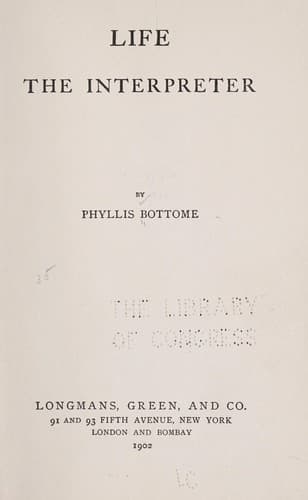
East End (London, England) -- Fiction; London (England) -- Social conditions -- Fiction; Social settlements -- Fiction
“I suppose,” said Muriel thoughtfully, “that depends on how one uses it;
one must carry things on to their farthest extent. I mean—it’s stifling
to be satisfied. If we go on far enough we shall come to a vista, and
it’s not till we get to see that things have no end that we are really
beginning at all. It is what you can’t grasp makes life worth living.”
Cynthia listened reluctantly.
“But love,” she said again, “you can grasp that; and it won’t go, will
it?”
“All that’s best and highest in love you can’t grasp, I think,” replied
Muriel. “It’s because one expects to do that that it hurts. The
invincible thrill of things is only meant as a launching into life.
After that friendship, comradeship, a blending of life to life and heart
to heart becomes unconscious development. Paroxysms aren’t love, and
they have their reaction; but love is beyond and through all, and even
in the most sad and sordid moments gleams and throbs an impossible
possibility! A thing always to strive for, never to attain!” Cynthia
rose and paced the room restlessly.
“Oh, Muriel! Muriel!” she said, “you don’t know——” Then she stopped
short, and went over and kissed her, an unusual demonstration from
Cynthia. “You’re so good,” she said, “and yet somehow so remote from it
all! I think I begin to see now why you didn’t marry Jack. I should have
faced it as you did, but I should have read the letters, talked about
them—and then married him!”
“And been unhappy ever afterwards,” said Muriel softly.
“Yes! but that’s nothing to do with it,” cried Cynthia impatiently. “I
acknowledge no afterwards. I would give myself body and soul to the man
I loved, like Browning’s lady, even if he were the greatest rascal
unhung!”
“That’s a horribly selfish theory!” said Muriel with sudden emphasis,
“and a very dangerous one. You would degrade yourself, hurt the man, and
ruin future generations, simply because of an effervescing passion,
which soon becomes stagnant if you give it time enough. No one can
afford to ignore consequences, least of all a lover. Why is it, do you
suppose, that these girls of mine, living like animals, working like
slaves, suffering like human beings, don’t oftener catch at this
passion-flower of yours, and take the poison of it? Simply because they
are face to face with the consequences. They can’t get away from
themselves, and their life is visible and public. They know what a few
days’ rapture implies—shame, pain, publicity, perhaps starvation. They
know that to cut off your nose spites your face, however you may wish to
make the surrender! You don’t risk a rapid when you see the rocks, only
when the rocks are hidden; the consequences ignored, then the selfish,
hopeless, aimless life gives in to its instincts; and though before the
leap you may have ignored the consequences, it will not prevent the
rocks beneath from grinding your life out after the fall.” She stopped,
her eyes flashing with the intensity of all she meant.
Public-domain text, read in full here on John Shaqi.
Reviews
Reviews
No reviews yet
Be the first to share your thoughts on this work.
Join the Discussion
Join the discussion
Sign in to leave a comment or review.
Sign InorCreate an account