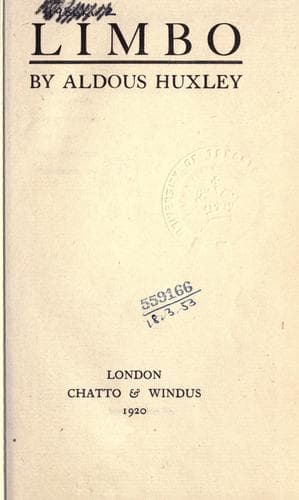
English drama -- 20th century; English fiction -- 20th century; Short stories, English
Marjorie also lay awake. She too felt herself distorted with misery.
How odiously cruel he had been, and how much she longed to forgive
him! Perhaps he would come in the dark, when all the house was asleep,
tiptoeing into the room very quietly to kneel by her bed and ask to be
forgiven. Would he come, she wondered? She stared into the blackness
above her and about her, willing him to come, commanding him--angry
and wretched because he was so slow in coming, because he didn't come
at all. They were both of them asleep before two.
Seven hours of sleep make a surprising difference to the state of
mind. Guy, who thought he was distorted for life, woke to find himself
healthily normal. Marjorie's angers and despairs had subsided. The
hour they had together between breakfast and Guy's departure was
filled with almost trivial conversation. Guy was determined to say
something about last's night incident. But it was only at the very
last moment, when the dog-cart was actually at the door, that he
managed to bring out some stammered repentance for what had happened
last night.
"Don't think about it," Marjorie had told him. So they had kissed and
parted, and their relations were precisely the same as they had been
before Guy came on leave.
* * * * *
George was sent out a week or two later, and a month after that they
heard at Blaybury that he had lost a leg--fortunately below the knee.
"Poor boy!" said Mr. Petherton. "I must really write a line to his
mother at once."
Jacobsen made no comment, but it was a surprise to him to find how
much he had been moved by the news. George White had lost a leg; he
couldn't get the thought out of his head. But only below the knee; he
might be called lucky. Lucky--things are deplorably relative, he
reflected. One thanks God because He has thought fit to deprive one of
His creatures of a limb.
"Neither delighteth He in any man's legs," eh? Nous avons changé tout
cela.
George had lost a leg. There would be no more of that Olympian speed
and strength and beauty. Jacobsen conjured up before his memory a
vision of the boy running with his great fawn-coloured dog across
green expanses of grass. How glorious he had looked, his fine brown
hair blowing like fire in the wind of his own speed, his cheeks
flushed, his eyes very bright. And how easily he ran, with long,
bounding strides, looking down at the dog that jumped and barked at
his side!
He had had a perfection, and now it was spoilt. Instead of a leg he
had a stump. _Moignon_, the French called it; there was the right
repulsive sound about _moignon_ which was lacking in "stump." Soignons
le moignon en l'oignant d'oignons.
Often, at night before he went to sleep, he couldn't help thinking of
George and the war and all the millions of _moignons_ there must be in
the world. He had a dream one night of slimy red knobbles, large
polyp-like things, growing as he looked at them, swelling between his
hands--_moignons_, in fact.
Public-domain text, read in full here on John Shaqi.
Reviews
Reviews
No reviews yet
Be the first to share your thoughts on this work.
Join the Discussion
Join the discussion
Sign in to leave a comment or review.
Sign InorCreate an account