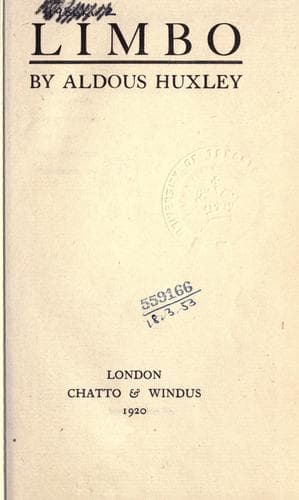
English drama -- 20th century; English fiction -- 20th century; Short stories, English
He had the right to be miserable. He was going back to France
to-morrow, he had trampled on his mistress's love, and he was
beginning to doubt himself, to wonder whether his whole life hadn't
been one ludicrous folly.
He reviewed his life, like a man about to die. Born in another age, he
would, he supposed, have been religious. He had got over religion
early, like the measles--at nine a Low Churchman, at twelve a Broad
Churchman, and at fourteen an Agnostic--but he still retained the
temperament of a religious man. Intellectually he was a Voltairian,
emotionally a Bunyanite. To have arrived at this formula was, he felt,
a distinct advance in self-knowledge. And what a fool he had been with
Marjorie! The priggishness of his attitude--making her read Wordsworth
when she didn't want to. Intellectual love--his phrases weren't always
a blessing; how hopelessly he had deceived himself with words! And now
this evening the crowning outrage, when he had behaved to her like a
hysterical anchorite dealing with a temptation. His body tingled, at
the recollection, with shame.
An idea occurred to him; he would go and see her, tiptoe downstairs to
her room, kneel by her bed, ask for her forgiveness. He lay quite
still imagining the whole scene. He even went so far as to get out of
bed, open the door, which made a noise in the process like a peacock's
scream, quite unnerving him, and creep to the head of the stairs. He
stood there a long time, his feet growing colder and colder, and then
decided that the adventure was really too sordidly like the episode at
the beginning of Tolstoy's _Resurrection_. The door screamed again as
he returned; he lay in bed, trying to persuade himself that his
self-control had been admirable and at the same time cursing his
absence of courage in not carrying out what he had intended.
He remembered a lecture he had given Marjorie once on the subject of
Sacred and Profane Love. Poor girl, how had she listened in patience?
He could see her attending with such a serious expression on her face
that she looked quite ugly. She looked so beautiful when she was
laughing or happy; at the Whites', for instance, three nights ago,
when George and she had danced after dinner and he had sat, secretly
envious, reading a book in the corner of the room and looking
superior. He wouldn't learn to dance, but always wished he could. It
was a barbarous, aphrodisiacal occupation, he said, and he preferred
to spend his time and energies in reading. Salvationist again! What a
much wiser person George had proved himself than he. He had no
prejudices, no theoretical views about the conduct of life; he just
lived, admirably, naturally, as the spirit or the flesh moved him. If
only he could live his life again, if only he could abolish this
evening's monstrous stupidity. . . .
Public-domain text, read in full here on John Shaqi.
Reviews
Reviews
No reviews yet
Be the first to share your thoughts on this work.
Join the Discussion
Join the discussion
Sign in to leave a comment or review.
Sign InorCreate an account