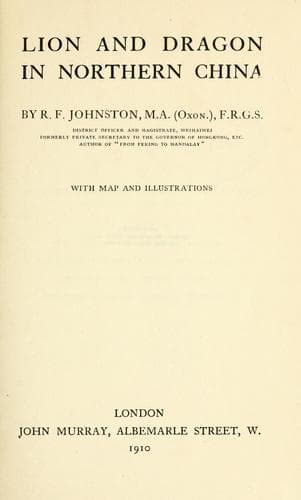
Lion and Dragon in Northern ChinaJohnston, Reginald Fleming, Sir
History
Lion and Dragon in Northern China
Johnston, Reginald Fleming, Sir
Weihai (China) -- History; Weihai (China) -- Social life and customs
The published chronicles do not carry us further than the middle of
the nineteenth century, though the yamêns of Wên-têng and Jung-ch'êng
possess all the information necessary for the production of new
up-to-date editions of their local histories as soon as the higher
provincial authorities issue the necessary orders. A new edition of the
_T'ung Chih_, the general Annals and Topography of the whole Province
of Shantung, is at present in course of preparation at the capital; and
to this work each of the magistracies will be required to contribute
its quota of information. If the work is brought up to recent times
it will be interesting to read its account of the war with Japan in
1894-5, and of the capture of Weihaiwei. Before the outbreak of that
war the fortifications of Weihaiwei had been entirely reconstructed
under the direction of European engineers. It was not, however, so
strong a fortress as Port Arthur, upon which six millions sterling had
been spent by the Government, and which was regarded by the Chinese as
impregnable. Yet Port Arthur fell to the victorious Japanese after a
single day's fighting, whereas Weihaiwei, vigorously attacked by land
and sea, did not capitulate till three weeks after the Japanese troops
had landed (on January 20, 1895) at the Shantung Promontory.
FOOTNOTES:
[20] A writer in the _Historians' History of the World_, published by
_The Times_ (see vol. xxiv. p. 683), says of the Chinese, that "up to
the advent of Europeans in the sixteenth century A.D. their records are
untrustworthy." This is an erroneous and most extraordinary statement.
The Chinese possessed valuable and, on the whole, reliable records
centuries before a single one of the modern States of Europe had begun
even to furnish material for history, far less produce trustworthy
historical records of its own.
[21] This story is related in that ancient book of marvels the _Shan
Hai Ching_ ("Hill and Sea Classic"). The princess is there said to have
been the daughter of the mythical Emperor Shên-nung (twenty-eighth
century B.C.). As a _ching wei_, the princess is said to have had a
white bill and red claws and to have been in appearance something like
a crow.
[22] See Legge's _Chinese Classics_, vol. iii. pt. 1. pp. 18 and 102-3.
[23] Ten was a sort of mystic number with the ancient Chinese. Lao Tzŭ,
the "Old Philosopher," for instance, is supposed to have had ten lines
on each hand and ten toes on each foot.
[24] These superstitions, which are treated seriously in the _Shan Hai
Ching_, are referred to in the _Lun Hêng_ of Wang Ch'ung, a writer of
the first century A.D. Wang Ch'ung decided that the ten suns could not
have been real suns, for if they had been in a Hot Water Abyss they
would have been extinguished, because water puts out fire; and if they
had climbed a tree their heat would have scorched the branches! (See
Forke's transl. of _Lun Hêng_, Luzac & Co: 1907, pp. 271 _seq._)
Public-domain text, read in full here on John Shaqi.
Reviews
Reviews
No reviews yet
Be the first to share your thoughts on this work.
Elsewhere in the archive
Join the Discussion
Join the discussion
Sign in to leave a comment or review.
Sign InorCreate an account