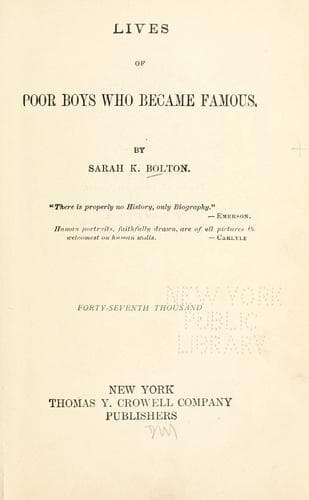
Lives of Poor Boys Who Became FamousBolton, Sarah Knowles
History
Lives of Poor Boys Who Became Famous
Bolton, Sarah Knowles
Biography
He went back to his garret to write, pawned his clothes to pay the
landlady, who was herself to be turned out of the wretched lodgings,
sold his "Life of Voltaire" for twenty dollars, and published his
"Polite Learning in Europe," anonymously. The critics attacked it, and
Goldsmith's day of fame had dawned at last. "The Citizen of the World,"
a good-natured satire on society, next appeared, and was a success. Dr.
Johnson became his friend, and made him a member of his club with
Reynolds, Burke, and other noted men. The "Traveller" was next
published, with an immense sale. Goldsmith now moved into the buildings
which bear his name, near Temple Church, and, for once, had flowers and
green grass to look out upon.
He was still poor, doubtless spending what money he received with little
wisdom. His landlady arrested him for room-rent, upon hearing which, Dr.
Johnson came at once to see him, gave him money, took from his desk the
manuscript of the "Vicar of Wakefield," and sold it to a publisher for
three hundred dollars. This was the fruit of much labor, and the world
received it cordially. Some of his essays were now reprinted sixteen
times. What a change from the Fleet Street garret!
The "Deserted Village" was published five years later, Goldsmith having
spent two whole years in reviewing it after it was written, so careful
was he that every word should be the best that could be chosen. This was
translated at once into German by Goethe, who was also a great admirer
of the "Vicar of Wakefield." He also wrote an English History, a Roman,
a Grecian, several dramas, of which "She Stoops to Conquer" was the most
popular, and eight volumes of the "History of the Earth and Animated
Nature," for which he received five hundred dollars a volume, leaving
this unfinished.
Still in debt, overworked, laboring sometimes far into the morning
hours, not leaving his desk for weeks together, even for exercise,
Goldsmith died at forty-five, broken with the struggle of life, but with
undying fame. When he was buried, one April day, 1774, Brick Court and
the stairs of the building were filled with the poor and the forsaken
whom he had befriended. His monument is in the Poets' Corner at
Westminster Abbey, the greatest honor England could offer. True, she let
him nearly starve, but she crowned him at the last. He conquered the
world by hard work, kindness, and a gentleness as beautiful as his
genius was great.
MICHAEL FARADAY.
In the heart of busy London, over a stable, lived James and Margaret
Faraday, with their four little children. The father was a blacksmith,
in feeble health, unable to work for a whole day at a time, a kind, good
man to his household; the mother, like himself, was uneducated, but neat
and industrious, and devoted to her family. The children learned the
rudiments of reading, writing, and arithmetic at school, and then, of
course, were obliged to earn their living.
Public-domain text, read in full here on John Shaqi.
Reviews
Reviews
No reviews yet
Be the first to share your thoughts on this work.
Join the Discussion
Join the discussion
Sign in to leave a comment or review.
Sign InorCreate an account