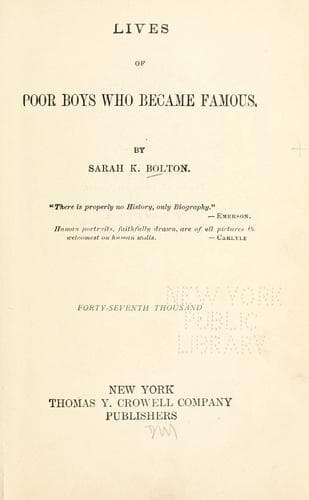
Lives of Poor Boys Who Became FamousBolton, Sarah Knowles
History
Lives of Poor Boys Who Became Famous
Bolton, Sarah Knowles
Biography
A customer at the shop had become interested in a boy who cared so much
for science, and took him to hear four lectures given by Sir Humphry
Davy at the Royal Institution. This was an unexpected pleasure. He was
beginning to sigh for something beyond book-binding. "Oh, if I could
only help in some scientific work, no matter how humble!" he thought to
himself. He says in his journal, "In my ignorance of the world, and
simplicity of my mind, I wrote to Sir Joseph Banks, President of the
Royal Society." No answer was ever returned to the request for a
situation. Could the president have realized that some day ten thousand
people would know the name of Michael Faraday where one knew the name of
Sir Joseph Banks, probably he would have answered the boy's letter.
Blessings on the great man or woman who takes time, however briefly, to
answer every letter received! Such a man was Garfield, and such is
Whittier. A civil question demands a civil answer, whether the person
addressed be king or peasant.
About the time his apprenticeship ended, in 1812, he summoned courage to
write directly to the great Sir Humphry Davy, sending the full notes he
had made at that gentleman's lectures. Sir Humphry, possibly remembering
that he, too, had been a poor boy, the son of a widowed milliner, wrote
a polite note, saying, that "Science was a harsh mistress, and, in a
pecuniary point of view, but poorly rewarding those who devoted
themselves to her service;" that he was going out of town, but would see
if he could some time aid him.
Meantime Michael was making crude galvanic experiments. He bought some
malleable zinc, cut out seven plates, each the size of a half-penny,
covered these with the copper half-pennies, placing between them six
pieces of paper soaked in a solution of muriate of soda, and with this
simple battery, decomposed sulphate of magnesia. So pleased was he that
he wrote a letter to one of his boy friends, telling of the experiment,
and adding, "Time is all I require. Oh, that I could purchase at a cheap
rate some of our modern gent's spare hours, nay, days! I think it would
be a good bargain, both for them and for me." The youth had learned the
first secret of success,--not to waste time; not to throw it away on
useless persons or useless subjects.
He had learned another secret, that of choosing right companions. To
this same young friend, Abbott, he wrote, "A companion cannot be a good
one, unless he is morally so. I have met a good companion in the lowest
path of life, and I have found such as I despised in a rank far superior
to mine.... I keep regular hours, and enter not intentionally into
pleasures productive of evil." London's highest circles possessed no
purer spirit than this young mechanic.
Public-domain text, read in full here on John Shaqi.
Reviews
Reviews
No reviews yet
Be the first to share your thoughts on this work.
Elsewhere in the archive
Join the Discussion
Join the discussion
Sign in to leave a comment or review.
Sign InorCreate an account