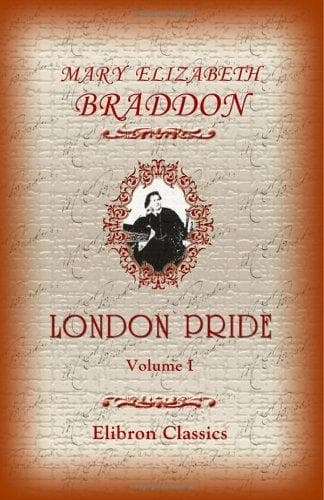
London Pride, Or, When the World Was YoungerBraddon, M. E. (Mary Elizabeth)
History
London Pride, Or, When the World Was Younger
Braddon, M. E. (Mary Elizabeth)
Great Britain -- History -- Charles II, 1660-1685 -- Fiction; London (England) -- Fiction
She remained long in prayer, repeating one of those litanies which she
had learnt in her infancy, and which of late had seemed to her to have
somewhat too set and mechanical a rhythm. The earnestness and fervour
seemed to have gone out of them in somewise since she had come to
womanhood. The names of the saints her lips invoked were dull and cold,
and evolved no image of human or superhuman love and power. What need
of intercessors whose personality was vague and dim, whose earthly
histories were made up of truth so interwoven with fable that she
scarce dared believe even that which might be true? In the One
Crucified was help for all sinners, gospel and creed, the rule of life
here, the promise of immortality hereafter.
The litanies to Virgin and Saints were said as a duty—a part of
implicit obedience which was the groundwork of her religion; and then
all the aspirations of her heart, her prayers for the sick man yonder,
her fears for her absent sister, for her father in his foreign
wanderings, went up in one stream of invocation to Christ the Redeemer.
To Him, and Him alone, the strong flame of faith and love rose, like
the incense upon an altar—the altar of a girl’s trusting heart.
She was so lost in meditation that she was unconscious of an
approaching footstep in the stillness of the deserted house, till it
drew near to the threshold of the sick-room. The night was close and
sultry, so she had left the door open, and that slow tread had crossed
the threshold by the time she rose from her knees. Her heart beat fast,
startled by the first human presence which she had known in that
melancholy place, save the presence of the pest-stricken sufferer.
She found herself face to face with a middle-aged gentleman of medium
stature, clad in the sober colouring that suggested one of the learned
professions. He appeared even more startled than Angela at the
unexpected vision which met his gaze, faintly seen in the dim light.
There was silence for a few moments, and then the stranger saluted the
lady with a formal reverence, as he laid down his gold-handled cane.
“Surely, madam, this mansion of my Lord Fareham’s must be enchanted,”
he said. “I left a crowd of attendants, and the stir of life below and
above stairs, only this forenoon last past. I find silence and vacancy.
That is scarce strange in this dejected and unhappy time; for it is but
too common a trick of hireling nurses to abandon their patients, and
for servants to plunder and then desert a sick house. But to find an
angel where I left a hag! That is the miracle! And an angel who has
brought healing, if I mistake not,” he added, in a lower voice, bending
over the speaker.
“I am no angel, sir, but a weak, erring mortal,” answered the girl,
gravely. “For pity’s sake, kind doctor—since I doubt not you are my
lord’s physician—tell me where are my dearest sister, Lady Fareham, and
her children. Tell me the worst, I entreat you!”
Public-domain text, read in full here on John Shaqi.
Reviews
Reviews
No reviews yet
Be the first to share your thoughts on this work.
Join the Discussion
Join the discussion
Sign in to leave a comment or review.
Sign InorCreate an account