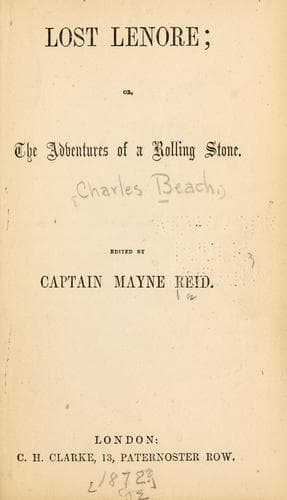
Lost Lenore: The Adventures of a Rolling StoneReid, Mayne
General
Lost Lenore: The Adventures of a Rolling Stone
Reid, Mayne
Adventure stories; Dime novels; Fiction
Conscience, or common sense, told me, that emigrants in a wilderness
might not look very favourably upon one, employed to protect them,
deserting from his duty, and taking property along with him--of which
every citizen of the United States believes himself to be the owner of a
share. They might not actually repel me. In all probability they would
give me something to eat; but they might also give information
concerning me--should I be pursued--that would enable my pursuers to
make a prisoner of me.
Before daybreak I awoke, having enjoyed a brief slumber; and, silently
mounting my horse, I rode beyond the emigrants' camp--deviating widely
from the trail to get around them.
I soon recovered the track; and pursued it as fast as my steed was
willing to carry me. When, looking out for a place where water could be
obtained--with the intention of stopping awhile and killing some bird or
animal for food--I came in sight of another party of emigrants, who were
just taking their departure from the spot where they had encamped for
the night.
I had put one train of these travellers between me and the fort; and now
fancied myself tolerably safe from pursuit. Riding boldly up to the
waggons, I told the first man I encountered, and in very plain terms
that I must have something to eat.
"Now, I like that way of talking," said he. "Had you asked for
something in the humble manner many would have done, perhaps you would
not have got it. People don't like to carry victuals five hundred
miles, to give away for nothing; but when you say you _must_ have
something to eat, then, of course, I can do nothing but give it to you.
Sally!" he continued, calling out to a young woman who stood by one of
the waggons, "get this stranger something to eat."
Looking around me, I saw a number of people--men, women, and children of
every age. There appeared to be three families forming the "caravan" no
doubt emigrating together, for the purpose of mutual protection and
assistance. There were five or six young men--who appeared to be the
sons of the elder ones--and a like number of young women, who were
evidently the daughters of three others of middle age, while a large
flock of miscellaneous children, a small flock of sheep, a smaller
number of cattle, several horses, and half-a-dozen half-famished dogs
completed the live-stock of the train.
"I guess you're a deserter?" said the man, to whom I had first addressed
myself, after he had finished his survey of myself and horse.
"No," I answered. "I'm on my route to Fort Wool. I have lost my way,
and gone without eating for two days."
"Now, I like that way of talking," responded the emigrant, who appeared
to be the head man of the party. "When a man tells me a story, I like
it to be a good one, and well told--whether I believe it, or not."
"What reason have you to disbelieve me?" I asked, pretending to be
offended at having my word doubted.
Public-domain text, read in full here on John Shaqi.
Reviews
Reviews
No reviews yet
Be the first to share your thoughts on this work.
Elsewhere in the archive
Join the Discussion
Join the discussion
Sign in to leave a comment or review.
Sign InorCreate an account