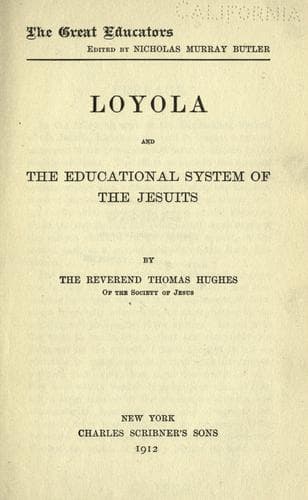
Loyola and the Educational System of the JesuitsHughes, Thomas
History
Loyola and the Educational System of the Jesuits
Hughes, Thomas
Education -- History; Ignatius, of Loyola, Saint, 1491-1556; Jesuits
As the second part of this book is intended to be a pedagogic analysis
of the mental culture imparted, I need not sketch here, save in a
general way, the intellectual scope proposed by Ignatius of Loyola, and
the method which he originated. Both scope and method vary somewhat,
according as the students contemplated are respectively external to the
Order, or members of it. The latter are to be qualified for becoming
future Professors, even though, in point of fact, only a certain
proportion of them become so.
Studious youth in general, including Ecclesiastics and Religious of
the various Orders, are considered by Ignatius as distributed amid two
kinds of educational institutions. One of these he calls the Public
School; the other, a University. The first is that which extends, in
its courses, from the rudiments of literature up to the lower level
of university education. He says: "Where it can conveniently be done,
let Public Schools be opened, at least in the departments of Humane
Letters."[62] In a note, he explains that Moral Theology may be treated
in a gymnasium of this kind. Father Aquaviva, in 1588, puts this
kind of school down as the lowest of three ranks of colleges; and
sums up the courses as being those of Grammar, Humanities, Rhetoric,
Languages, and Moral Theology.[63] He also explains why the lowest
Jesuit curriculum must fill these requirements, "in order that the
Society be not defrauded of the end it has in view, which is, to carry
the students on at least as far as mediocrity in learning, so that they
may go forth into their respective vocations, Ecclesiastics to their
ministry, lay students to their own work in life, qualified in some
degree with a sufficiency of literary culture."[64] This curriculum
served also the purpose of those, who, while members of the Order,
were for some reason dispensed from the full course of studies.[65] If
any grades are wanting in a college, it must be the lower ones which
are omitted, the higher being retained.[66] Ignatius goes on to limit
the courses in a gymnasium of this kind: "Let not higher sciences be
treated here; but, to pursue them, the students who have made due
progress in literature are to be sent from these colleges to the
universities.[67]
Passing on to universities of the Order, he defines for their scope,
first, in behalf of those who are to be Ecclesiastics, Scholastic
Theology, Holy Scripture, and Positive Theology; secondly, for all
students, Humane Letters, Latin, Greek, Hebrew, and other such
languages as Chaldaic, Arabic, and Indian, subject to the demands of
necessity or utility; moreover, Logic, Physics, Metaphysics, Moral
Philosophy, and Mathematics. All these departments are to be provided
for by Professors of the Order. If the departments of Civil Law and
Medicine are added, they will be conducted by Professors not of the
Society.[68]
Public-domain text, read in full here on John Shaqi.
Reviews
Reviews
No reviews yet
Be the first to share your thoughts on this work.
Join the Discussion
Join the discussion
Sign in to leave a comment or review.
Sign InorCreate an account