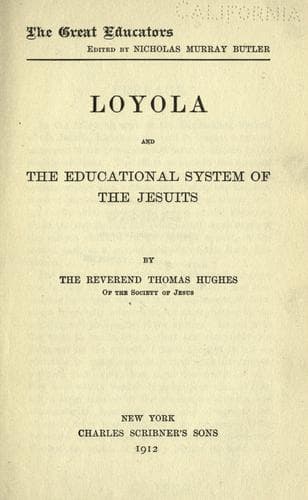
Loyola and the Educational System of the Jesuits — John Shaqi
Loyola and the Educational System of the JesuitsHughes, Thomas
History
Loyola and the Educational System of the Jesuits
Hughes, Thomas
Education -- History; Ignatius, of Loyola, Saint, 1491-1556; Jesuits
As to the Scholastic members of the Society, their mental culture in
the Order begins, of course, where their collegiate curriculum had
closed, that is, at the end of their classical course. Their studies
henceforth are defined by two objects; one, that of professing, as
formed Jesuits in the future, what they are studying now; the other,
that of being differentiated, according to talent and circumstance,
into preachers, writers, directors of consciences, or managers of
affairs.
In view of this two-fold object, all the examinations, arranged for
members of the Order in the advanced courses, are regulated by one
standard, that the Jesuit Scholastics must be found competent, at each
stage, to teach the course in which they are being tested. Accordingly,
they review their previous literary acquirements, in all the lines
which the Society regularly professes; then, during three years, they
apply exclusively to Philosophy and Natural Sciences; and, four years
more, to Divinity and allied Sciences.[69]
This protracted course, therefore, as given more in detail by the
subsequent _Ratio_, consists of Poetry, Rhetoric, and Literature;
Mathematics, Physics, and Chemistry; Logic, Ontology, Cosmology,
Psychology, and Natural Theology; Ethics, Natural, Social and Public
Right, Moral Theology, Canon Law, Ecclesiastical History, Scholastic
Theology, Hebrew, Sacred Scripture. The courses are to be pursued
either in the same classes which external students attend, or, in their
own university classes, when a general house of studies is formed as a
"Scholasticate." In both cases, they have Seminary exercises of their
own, beyond what is required in the most condensed university courses.
Those whom health and excellence have approved at every step are
ordinarily to be withdrawn from studies, "when the course of Arts has
been finished, and when four years have been spent on Theology."[70]
Specialties are to be cultivated.[71] Subsequent legislation places
these specialties in the interval between the Arts and Theology; and,
again, after the latter.
This, in brief, is the practical idea of the Professorial Seminaries,
philological, philosophical, scientific, and theological, through
which the stream of future Professors is continually passing. Each
one is subject, at every stage, to examination tests which include
the most distinct reference to professorial capacity. The technical
standard in the examinations is that of "surpassing mediocrity," which
term is accurately defined, as we shall see later, when analyzing the
_Ratio_.[72]
Public-domain text, read in full here on John Shaqi.
Reviews
Reviews
No reviews yet
Be the first to share your thoughts on this work.
Join the Discussion
Join the discussion
Sign in to leave a comment or review.
Sign InorCreate an account