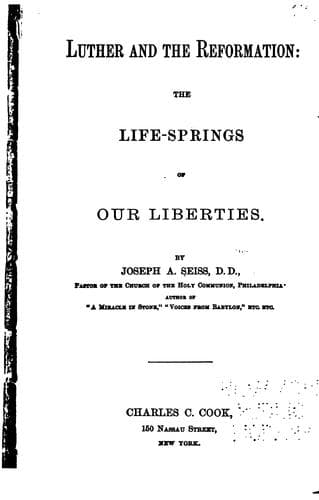
Luther and the Reformation:: The Life-Springs of Our LibertiesSeiss, Joseph Augustus
History
Luther and the Reformation:: The Life-Springs of Our Liberties
Seiss, Joseph Augustus
Luther, Martin, 1483-1546; Pennsylvania -- History -- Colonial period, ca. 1600-1775
For three months the Diet wrangled over the affair of Luther without
reaching anything decided. The friends of Rome were the chief actors,
struggling in every way and hesitating at nothing to induce the Diet
and the emperor to acknowledge and enforce the pope's decree. But the
influence of the German princes, especially that of the Elector
Frederick, stood in the way; Charles would not act, as he had no right
to act, without the concurrence of the states, and the princes of
Germany held it unjust that Luther should be condemned on charges
which had never been fairly tried, on books which were not proven to
be his, and especially since the sentence itself presented conditions
with reference to which no answer had been legally ascertained.
To overcome these oppositions different resorts were tried. Leo issued
a second Bull, excommunicating Luther absolutely, anathematizing him
and all his friends and abettors. The pope's legate called for money
to buy up influence for the Romanists: "We must have money. Send us
money. Money! money! or Germany is lost!" The money came; but the
Reformer's friends could not be bought with bribes, however much the
agents of Rome needed such stimulation.
Trickery was brought into requisition to entrap Luther's defenders by
a secret proposal to compromise. Luther was given great credit and
right, except that he had gone a little too far, and it was only
necessary to restrain him from further demonstrations. Rome compromise
with a man she had doubly excommunicated and anathematized! Rome make
terms with an outlaw whom she had infallibly doomed to eternal
execration! Yet with these proposals the emperor's confessor
approached Chancellor Brueck. But the chancellor's head was too clear
to be caught by such treachery.
Then it was moved to refer the matter to a commission of arbitrators.
This met with so much favor that the pope's legate, Aleander, was
alarmed lest Luther should thereby escape, and hence set himself with
unwonted energy to incite the emperor to decisive measures.
Charles was persuaded to make a demonstration, but demanded that the
legate should first "convince the Diet." Aleander was the most famous
orator Rome had, and he rejoiced in his opportunity. He went before
the assembly in a prepared speech of three hours in length to show up
Luther as a pestilent heretic, and the necessity of getting rid of him
and his books and principles at once to prevent the world from being
plunged into barbarism and utter desolation. He made a deep impression
by his effort. It was only by the unexpected and crushing speech of
Duke George of Saxony, Luther's bitter personal enemy, that the train
of things, so energetically wrought up, was turned.
Public-domain text, read in full here on John Shaqi.
Reviews
Reviews
No reviews yet
Be the first to share your thoughts on this work.
Join the Discussion
Join the discussion
Sign in to leave a comment or review.
Sign InorCreate an account