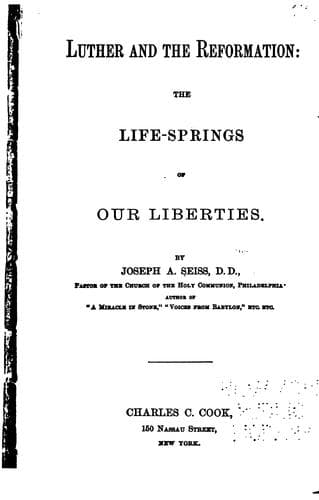
Luther and the Reformation:: The Life-Springs of Our LibertiesSeiss, Joseph Augustus
History
Luther and the Reformation:: The Life-Springs of Our Liberties
Seiss, Joseph Augustus
Luther, Martin, 1483-1546; Pennsylvania -- History -- Colonial period, ca. 1600-1775
Not in defence of Luther, whom he disliked, but in defence of the
German nation, he piled up before the door of the hierarchy such an
overwhelming array of its oppressions, robberies, and scandals, and
exposed with such an unsparing hand the falsities, profligacies,
cupidity, and beastly indecencies of the Roman clergy and officials,
that the emperor hastened to recall the edict he had already signed,
and yielded consent for Luther to be called to answer for himself.
LUTHER SUMMONED.
In vain the pope's legate protested that it was not lawful thus to
bring the decrees of the sovereign pontiff into question, or pleaded
that Luther's daring genius, flashing eyes, electric speech, and
thrilling spirit would engender tumult and violence. On March 6th the
emperor signed a summons and safe-conduct for the Reformer to appear
in Worms within twenty-one days, to answer concerning his doctrines
and writings.
So far the thunders of the Vatican were blank.
With all the anxious fears which such a summons would naturally
engender, Luther resolved to obey it.
The pope's adherents fumed in their helplessness when they learned
that he was coming--coming, too, under the safe-conduct of the empire,
coming to have a hearing before the Diet!--_he_ whom the infallible
Vicar of Heaven had condemned and anathematized! Whither was the world
drifting?
Luther's friends trembled lest he should share the fate of Huss; his
enemies trembled lest he should escape it; and both, in their several
ways, tried to keep him back.
Placards of his condemnation were placed before him on the way, and
spectacles to indicate his certain execution were enacted in his
sight; but he was not the man to be deterred by the prospect of being
burnt alive if God called for the sacrifice.
Lying fraud was also tried to seduce and betray him. Glapio, the
emperor's confessor, who had tried a similar trick upon the Elector
Frederick, conceived the idea that if Von Sickingen and Bucer could be
won for the plot, a proposal to compromise the whole matter amicably
might serve to beguile him to the chateau of his friend at Ebernburg
till his safe-conduct should expire, and then the liars could throw
off the mask and dispose of him with credit in the eyes of Rome. The
glib and wily Glapio led in the attempt. Von Sickingen and Bucer were
entrapped by his bland hypocrisy, and lent themselves to the execution
of the specious proposition. But when they came to Luther with it, he
turned his back, saying, "If the emperor's confessor has anything to
say to me he will find me at Worms."
Public-domain text, read in full here on John Shaqi.
Reviews
Reviews
No reviews yet
Be the first to share your thoughts on this work.
Join the Discussion
Join the discussion
Sign in to leave a comment or review.
Sign InorCreate an account