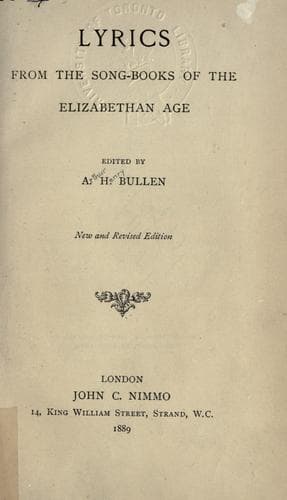
Ballads, English -- Texts; English poetry -- Early modern, 1500-1700; Songs, English -- England -- Texts
On a time the amorous Silvy
Said to her shepherd, 'Sweet, how do you?
Kiss me this once, and then God be wi' you,
My sweetest dear!
Kiss me this once and then God be wi' you,
For now the morning draweth near.'
With that, her fairest bosom showing,
Opening her lips, rich perfumes blowing,
She said, 'Now kiss me and be going,
My sweetest dear!
Kiss me this once and then be going,
For now the morning draweth near.'
With that the shepherd waked from sleeping,
And, spying where the day was peeping,
He said, 'Now take my soul in keeping,
My sweetest dear!
Kiss me, and take my soul in keeping,
Since I must go, now day is near.'
From ROBERT JONES' _First Book of Songs and Airs_, 1601.
Once did I love and yet I live,
Though love and truth be now forgotten;
Then did I joy, now do I grieve
That holy vows must now be broken.
Hers be the blame that caused it so,
Mine be the grief though it be mickle;[12]
She shall have shame, I cause to know
What 'tis to love a dame so fickle.
Love her that list, I am content
For that chameleon-like she changeth,
Yielding such mists as may prevent
My sight to view her when she rangeth.
Let him not vaunt that gains my loss,
For when that he and time hath proved her,
She may him bring to Weeping-Cross:
I say no more, because I loved her.
[12] Old ed., "little"
From HENRY YOULL's _Canzonets to Three Voices_, 1608.
Once I thought to die for love,
Till I found that women prove
Traitors in their smiling:
They say men unconstant be,
But they themselves Jove change, we see,
And all is but beguiling.
From THOMAS WEELKES' _Madrigals_, 1597
Our country-swains in the morris dance
Thus woo and win their brides,
Will for our town the hobby horse
At pleasure frolic rides:
I woo with tears and ne'er the near,
I die in grief and live in fear.
From GILES FARNABY's _Canzonets_, 1598.
Pierce did love fair Petronel
Because she sang and danced well
And gallantly could prank it;
He pulled her and he haul'd her
And oftentimes he call'd her
Primrose pearls prick'd in a blanket.
From FRANCIS PILKINGTON's _First Set of Madrigals and Pastorals_, 1613.
Pour forth, mine eyes, the fountains of your tears;
Break, heart, and die, for now no hope appears;
Hope, upon which before my thoughts were fed,
Hath left me quite forlorn and from me fled.
Yet, see, she smiles! O see, some hope appears!
Hold, heart, and live; mine eyes, cease off your tears.
From _Airs sung and played at Brougham Castle_, 1618, by GEORGE MASON
and JOHN EARSDEN.
Public-domain text, read in full here on John Shaqi.
Reviews
Reviews
No reviews yet
Be the first to share your thoughts on this work.
Join the Discussion
Join the discussion
Sign in to leave a comment or review.
Sign InorCreate an account