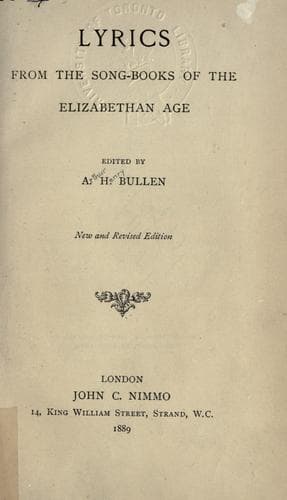
Ballads, English -- Texts; English poetry -- Early modern, 1500-1700; Songs, English -- England -- Texts
Silly boy! 'tis full moon yet, thy night as day shines clearly;
Had thy youth but wit to fear, thou couldst not love so dearly.
Shortly wilt thou mourn when all thy pleasures be bereaved,
Little knows he how to love that never was deceived.
This is thy first maiden-flame that triumphs yet unstained,
All is artless now you speak, not one word is feigned;
All is heaven that you behold, and all your thoughts are blessed,
But no spring can want his fall, each Troilus hath his Cressid.
Thy well-ordered locks ere long shall rudely hang neglected,
And thy lively pleasant cheer read grief on earth dejected;
Much then wilt thou blame thy Saint, that made thy heart so holy
And with sighs confess, in love that too much faith is folly.
Yet be just and constant still, Love may beget a wonder,
Not unlike a summer's frost or winter's fatal thunder:
He that holds his sweetheart true unto his day of dying,
Lives, of all that ever breathed, most worthy the envying.
From GILES FARNABY's _Canzonets_, 1598.
Simkin said that Sis was fair,
And that he meant to love her;
He set her on his ambling mare,--
All this he did to prove her.
When they came home Sis floted cream
And poured it through a strainer,
But sware that Simkin should have none
Because he did disdain her.
From THOMAS FORD's _Music Of Sundry Kinds_, 1607.
Since first I saw your face I resolved to honour and renown ye,
If now I be disdained I wish my heart had never known ye.
What? I that loved and you that liked shall we begin to wrangle?
No, no no, my heart is fast, and cannot disentangle.
If I admire or praise you too much, that fault you may forgive me
Or if my hands had strayed but a touch, then justly might you leave me.
I asked you leave, you bade me love; is't now a time to chide me?
No no no, I'll love you still what fortune e'er betide me.
The sun whose beams most glorious are, rejecteth no beholder,
And your sweet beauty past compare made my poor eyes the bolder,
Where beauty moves, and wit delights and signs of kindness bind me
There, O there! where'er I go I'll leave my heart behind me.
From THOMAS MORLEY's _First Book of Ballets_, 1595.
Sing we and chant it
While love doth grant it.
Fa la la!
Not long youth lasteth,
And old age hasteth.
Fa la la!
Now is best leisure
To take our pleasure.
Fa la la!
All things invite us
Now to delight us.
Fa la la!
Hence care be packing,
No mirth be lacking.
Fa la la!
Let spare no treasure
To live in pleasure.
Fa la la!
From THOMAS BATESON's _First Set of English Madrigals_, 1604.
Public-domain text, read in full here on John Shaqi.
Reviews
Reviews
No reviews yet
Be the first to share your thoughts on this work.
Join the Discussion
Join the discussion
Sign in to leave a comment or review.
Sign InorCreate an account