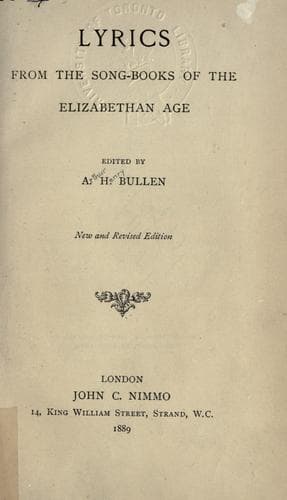
Ballads, English -- Texts; English poetry -- Early modern, 1500-1700; Songs, English -- England -- Texts
And said "Jove speed, dame Fly, dame Fly":
"Marry, you be welcome, Sir," quoth she:
"The master Humble Bee hath sent me to thee
To wit and if you will his true love be."
But she said "Nay, that may not be,
For I must have the Butterfly,
For and a greater lord there may not be."
But at the last consent did she.
And there was bid to this wedding
All Flies in the field and Worms creeping.
The Snail she came crawling all over the plain,
With all her jolly trinkets in her train.
Ten Bees there came, all clad in gold,
And all the rest did them behold;
But the Thornbud refused this sight to see,
And to a cow-plat away flies she.
But where now shall this wedding be?--
For and hey-nonny-no in an old ivy-tree.
And where now shall we bake our bread?--
For and hey-nonny-no in an old horse-head.
And where now shall we brew our ale?--
But even within one walnut-shale.
And also where shall we our dinner make?--
But even upon a galled horse-back:
For there we shall have good company
With humbling and bumbling and much melody.
When ended was this wedding-day,
The Bee he took his Fly away,
And laid her down upon the marsh
Between one marigold and the long grass.
And there they begot good master gnat
And made him the heir of all,--that's flat.
From THOMAS WEELKES' _Airs or Fantastic Spirits_, 1608.
_Audivere, Lyce_.--HORACE.
The gods have heard my vows,
Fond Lyce, whose fair brows
Wont scorn with such disdain
My love, my tears, my pain.
Fa la!
But now those spring-tide roses
Are turn'd to winter-posies,
To rue and thyme and sage,
Fitting thy shrivell'd age.
Fa la!
Now, youths, with hot desire
See, see, that flameless fire,
Which erst your hearts so burned,
Quick into ashes turned.
Fa la!
From _Pammelia_, 1609
_The household-bird with the red stomacher._--DONNE.
The lark, linnet and nightingale to sing some say are best;
Yet merrily sings little Robin, pretty Robin with the red breast.
From RICHARD CARLTON's _Madrigals_, 1601.
The love of change hath changed the world throughout,
And what is counted good but that is strange?
New things wax old, old new, all turns about,
And all things change except the love of change.
Yet find I not that love of change in me,
But as I am so will I always be.
From JOHN DOWLAND's _Third and last Book of Songs and Airs_, 1603.
The lowest trees have tops, the ant her gall,
The fly her spleen, the little spark his heat;
And slender hairs cast shadows, though but small,
And bees have stings, although they be not great;
Seas have their source, and so have shallow springs;
And love is love, in beggars and in kings!
Public-domain text, read in full here on John Shaqi.
Reviews
Reviews
No reviews yet
Be the first to share your thoughts on this work.
Elsewhere in the archive
Join the Discussion
Join the discussion
Sign in to leave a comment or review.
Sign InorCreate an account